"The baby's name was Born Dancin'...The baby and I sit happily on the floor, side by side, tearing pages out of books, and sometimes, just for fun, we go out on the street and smash a windshield together." Donald Barthelme.
Everyone knows that giant robots are way up there in the list of humankind's greatest aesthetic achievements (along with kitsch animal paintings, imaginary maps and Religious anti-self-abuse literature) so it's great to see Michael Jackson supplementing his already impressive contribution to Western culture with his latest enterprise.
"Michael Jackson is in discussions about creating a 50-foot robotic replica of himself to roam the Las Vegas desert, according to reports.
The pop legend is currently understood to be living in the city, as he considers making a comeback after 2004's turbulent child sex case.
It has now been claimed that his plans include an elaborate show in Vegas, which would feature the giant Jacko striding around the desert, firing laser beams.
If built, the metal monster would apparently be visible to aircraft as they come in to land in the casino capital. It is the centerpiece of an elaborate Jackson-inspired show in Vegas, according to Andre Van Pier, the robot's designer.
Luckman Van Pier, his partner at the company behind the proposal, claims blueprints have been drawn up for the show and seen by the star.
"Michael's looked at the sketches and likes them," he told the New York Daily News.
On the subject of the robot, he continued: "It would be in the desert sands. Laser beams would shoot out of it so it would be the first thing people flying in would see."
The End Times are upon us, my children. Well, maybe not, but it's been quite the theological fortnight for me.
A few weekends back I had a much belated co-birthday party with a cult theme, which was visited by some angels and demons and non-denominational unearthly figures. Fun stuff. I call this guy Pig Jeebus and I'm pretty sure he's what the future of the human race will look like once we sort out all this human-pig cross-cloning business which is surely what's keeping the eggheads from attending to the global warming stuff.
Then on Friday night I ended up at a bar which might well be one of Dante's circles of Hell. At one point I was wandering around a room that looked like Heironymous Bosch had eaten the palace at Versailles and then upchucked all over Tony Montana's Miami mansion, when I turned to a friend and said "this is horrible". He immediately replied "I was just thinking 'horrific'". It was the kind of place you'd see in an 80s straight-to-video flick starring Mickey Rourke in which his investigation of a mysterious and big-haired femme fatale takes him deep into a labyrinth of passion and murder. The title would be some combination of the words "obsession", "naked", "deadly" and "hidden" and he'd end up at this club that masks a cult of demon-worshippers who perform unspeakable rituals in the basement. The club would be supposed to come across as all decadent and evilly lavish, but you'd be thinking "No, that's Mickey Rourke, and like him it just looks tasteless and cheap."
So that's where I ended up on Friday. If you want to know what circle of Hell you belong in, go here.
Saturday over lunch I was somehow talking about Satanism with someone, who was idly pointing out that it rests on pretty solid and non-baby-sacrifice requiring philosophical principles. But we agreed that it's probably not worth pursuing too seriously. He pointed out that even if it is sound in a theoretical way, you might be better off just not taking the risk. If you turn out to be wrong, well, you've really blown your chances. I just pointed out that it's really, really uncool to tell people you're a Satanist.
Yesterday I opened the newspaper to find a story on Pastafarianism, which struck me immediatley since I'd been explaining it to someone on Friday. That was eerie. I hadn't thought about the Flying Spaghetti Monster in years, and here is was, twice in less than a week.
But all of this is nothing compared to the strangeness of the new Christian web revolution, which seems aimed at taking absolutely everything you can find on the internet and God-ifying it.
Conservapedia is great. Some people noted that wikipedia was really a godless hive of anti-Christian slander, and was in fact "six times more liberal than the American public". Conservapedia replaces wikipedia's pagan bias with the true voice of the Lord, so you'll find articles explaining how kangaroos made it from Noah's Ark to Australia. They probably got here on rafts made of matted vegetation, apparently.
And since YouTube is all wicked teens miming to The Rapture and people videoing their warcraft battles, it's no wonder that some good soul came up with GodTube, which allows people to spread the word of the lord by uploading nice religious videos. It's awesome.
Here's someone explaining how proof of God's existence can be found in the humble banana, though you could very easily use his explanation to support something else.
And here's someone's take on the classic, if not quite Jesus-positive song "Baby Got Back", now changed to "Baby Got Book" (or "Baby Got Bible" - it's not entirely clear.)
Ladies? “Yeah!” Ladies? “Yeah!” Do you want to save people from Hades? “Yeah!”
As I will be away from my computer most of this week, I thought I'd post the following videos before I forget. They're pretty much the best things in existence right now (subject to council approval) so I didn't want them to go the way of all things internet, ie into the gaping maw of forgetfulness, which looks remarkably like the gaping maw of a hungry hungry hippo, but with less spite.
Baby Sloth or Skating Robot? Must we take sides?
YOU BE THE JUDGE (and wield your gavel judiciously).
If I was ever going to lie about my age, I'd be saying I was in my 80s just so I could be associated with the bitchingest decade ever: the 1920s. If they ever have the 1920s again, I'm so first in line.
"Take a number, bub."
The 20s pretty much gave and gave and gave. What other decade came up with flappers, dancing on the wings of biplanes, going out to find some hooch without it suggesting something sleazy, really good cocktails, and much more. The women all spewed acerbic witticisms in vaguely New England accents while careening around the countryside in white-walled cadillacs with running boards, and the men all wore tuxedoes (even to bed!) and said "spiffo" a lot. There was surrealism and futurism and existentialism and some very nice poetry but really, that was just window-dressing. When the 1920s came along, they essentially just hung out a big sign saying "HEY LETS PARTY it'll be div" and let things rip from there on in.
"Let yourself out, toots, I'm too stinko to get me up."
They called it the Roaring Twenties. Can you imagine what a decade would have to do to be called "Roaring" these days? Think about it, the Roaring Noughties. It sounds like an old timey euphemism for genital inflammation. That said, if any burlesque troupes want to take on the name The Roaring Noughties, it's yours.
But one thing I've just realised is where the 20s let us down. Because looking at old footage like this:
I've come to understand that THE CHARLESTON IS THE DUMBEST DANCE EVER. Now that clip starts off with both a drunk-looking flapper and some liveried dancing midget, which should be a sure sign of gold. But where did the 20s go wrong? Was it all that cheap hooch and smoking cigars in the bathtub and somesuch that addled people's brains?
There's some great dancing in here, but when you get to the point where the fur-coated women are attempting to charleston across the street, I'm sure you'll agree with me.
And that's not to mention the bastard younger sibling dance move, Monkey Knees.
Wherein, believe it or not, it actually appears as if one is swapping one's knees. The drollery. And while normally a solitary vice, the above image suggests multi-party monkey knees, though this may have just been a cunning way to exchange drugs or phone numbers or something.
But what also strikes me is the similarity between the robotic mindlessness of the charleston and that moronic-yet-hypnotic French (or Belgian) Jump I posted a little while back. The following clip illustrates it well, and is one of the few good demonstrations of the Charleston I've been able to find.
Maybe if more Charleston dancers had been as fly as these guys, and had been doing it to some old Daft Punk track, well, things would have turned out a little different (IE NO WAR AND/OR PROHIBITION?)
I don't pretend to have all the answers, but sometimes I can't even think of the questions, either. Here's a case in point: unless the question is "Why has someone recreated the final battle scene from Star Wars using... lots of hands?" all I can say is:
"Dude, wtf?"
Here's what George Lucas was doing all those years between Return of the Jedi and that other one with the kid with the bowl haircut.
I've never been a fan of Jethro Tull, with their fey Celtic melodies and oh-so-quirky prog rock imagery. Since they were proudly anti-drug, it always seemed a bit lame that they ran off the back of psychedelic videos that just didn't quite cut it. Kind of like when you're a little kid, and you pretend to be drunk by imitating drunk people you've seen in movies and on TV. But lord, you don't base your career around it.
Still, the following video has got to be one of the stranger ones of the period, and I think it might be that drugs or no, frontman Ian Anderson was, actually, quite insane.
But while the Tull just could have been losers, I'd stop short of calling them complete morons.
On the other hand, I recently received an email with the subject line "A bunch of idiots review 1984," a line I instantly fell in love with and which I decided to title my autobiography.
Being exactly what it sounds like, it's some chap's (CAN WE REALLY KNOW ON THE INTERNET?) collection of great reviews of Orwell's 1984 as taken from amazon.com.
It contains such gems as:
"Let's try to be a little more optomistic, and work on a happier ending, shall we?"
"Thus, it doesn't make any sense to think that a novel like this one is really any better than say, Michael Crichton or Stephen King."
"This book isn't as good as Harry Potter in MY opinion, and no one can refute me. "
"first of all its NOTHING like the future is probly going to turn out."
"Maybe if you live in a country that's a monarchy, this book's worth reading, but this is *America*, ok? The whole reason we live in a democracy is so that we the people don't have to worry about things like this. "
"please george do us all a faver and stop writing books."
"It's 2000. 1984 was a bad movie with Michael J. Fox. "
People often ask me how to fix up their rubbish lives and the world and stuff. At least, a whole series of strangers decided to do that last Friday night in a very weird hour or two at a bar. It turned out that my oracle/life coach skills are at a much higher level than I realised, as every one of these people walked away happy and warmed in their hearts as if little cosy hearths had been stoked there (metaphorically - never try lighting an actual fire in your chest cavity).
I tend not to give advice so this was an exceptional night, but I think that one piece of advice that can never go astray is pretty clear here - you can never really go wrong dancing. I mean, I suppose you can go wrong dancing in lots of ways, but it's never going to deplete our dwindling water supplies or kill a whale or contribute to global warming in a significant way.
My good friend Mark knows me well enough to have emailed me the following link today:
How to do the Robot. As the title suggests, it's a sequence of instructional videos on robot dancing. My favourite part is the fact that the guy doing it seems neither particularly exceptional at the robot nor particularly interested in it. It's as if he wants to be excited, but he'd really just rather be chilling on the couch with a beer and his Wii.
This kid really knows his robot, though; wait until the weedy dude in the orange skivvy shows up, as he actually contributes several original moves to the form. The robot pirouette is at a very high degree of difficulty.
Someone really needs to get over to Europe and work out why so many ravers have become possessed by jumpstyle (this horrible move that becomes quite hypnotic when performed in unison by dozens of the freaks - which is exactly what happens).
Can't stand the music, or the outfits, or the very idea, but how on earth in this day and age can grown people become obsessed with a "move" a la the macarena or something? It disturbs, even moreso since there seems to be nothing written about it anywhere, only youtube videos, so I can't even trace the phenomenon.
The Belgian Jump is even weirder. What's going on with these freakin' kids? It's like one starts doing it and the others get infected with this crazy epileptic move and can't help all rushing out to join in.
In the Nederlands it's quite horrible, taking over shopping malls. Here's a TV spot on it:
We're on an extended hiatus here at Born Dancin' Enterprises, with the potential never to come back to this internet thing, since it seems such a 2006 kind of place. But just when you thought there was nothing left to it, something like this comes along, combining Dick Van Dyke dancing with Herbie Hancock Rockitt-ing. And if this guy wasn't born dancin', I don't know who was.
This is pretty much me all day, every day, including the black and white and the bit with the marionette-strings and the giant scissors. If like to imagine one day in the future, when Richard Wayne Van Dyke shuffles off this mortal coil, that he'll be mixing it up with a little Tamil electro-midget in the great dancehall in the sky. But I try not to imagine it too much, since it hurts my head.
When I think back to the halcyon salad days which surrounded this site's first infant stumblings, I am often given occasion to grow misty-eyed as I feel the corners of my mouth curl skyward. You must remember that this was a time of perpetual summer and frequent canape and cocktail-including afternoons on the forelawns of various embassies, chancellor's abodes and presbyteries, the soft murmur of charming bon mots interrupted by the ringing of clear crystal glasses meeting for a brief communion and the occasional yelp of a lolly-limbed puppy scrabbling beneath the legs of a wrought-iron outdoor table. You will of course note that this was way back in 2005, when the internet was still in its fledgling state, barely more than a couple of wooden boxes connected by rough twine. How things have changed. Way back when, I started this site in a half-hearted attempt to document my impressions of the Melbourne shows I'd caught and hadn't written about elsewhere, whether it be theatre, dance, the occasional art opening or film screening, whatever. Less reviews, than impressions. Nowadays we've reached the point where there are others far more committed and energetic and worth reading than I ever was, and you can tell the health of this burgeoning online theatre community by the fact that the last week or so has seen its very first stoush. Not exactly the sort of Wild West gunfight to have onlookers scrabbling a path through the sawdust to leap out windows in order to avoid the crossfire, but enough to generate some really interesting discussion, which certainly hasn't been resolved and hopefully, in a sense, never will be.
It all began when the very esteemed Theatre Notes published a short non-review of Theatre @ Risk's Requiem for the 20th Century, which wasn't exactly full of praise: "it seemed to me a mistake of disastrous proportions" isn't really something you'd want your work tarred with. This set off some interesting comments debating the duty of a critic. The show's director later emailed the writer and argued that it was hardly fair to make such comments about a show when, by the author's own admission, she'd left at interval. This sparked more commentary, which spread to other blogs, and also made me aware of a whole swag of new-ish theatre blogs covering Melbourne which I hadn't known about previously. Excellent, for that alone.
Anyway, as is probably obvious, I haven't really been reviewing much lately, mainly because I have been too busy but also because I figure you're all grown up now and no longer have the need to accost your sensorium with the critical equivalent of a drunk barfly trying to explain to you the show he thought he saw on the tube last night but could well be a product of his imagination and can I have one of those what are these my name'sh Born oh I already told you haha sob.
But I saw Requiem on Sunday, and I thought I'd weigh on the debate (which is probably now over, since the show is). It's worth noting before I start that in a sense, I'm not weighing in much at all, since the debate itself wasn't really about the show; it was about the duties of reviews, the rights of theatremakers, the expectations of audiences and those who read reviews, and so on. This could have been spurred on by any piece of writing. Anyway, this isn't a corrective to Alison's original (non-)review. But as I commented there, I'm a little stumped as to how some people had such an extreme reaction. I can see how some would have felt it didn't work, or was too safe, or didn't succeed at what it was trying to do (not my reactions). But disastrous?
Huh?
The piece purports to offer a "theatrical tour through the last century"; it's more than two and a half hours spanning the first half of the 20th century, with a central plotline involving the doomed romance of a pair of lovers with uncountable cameos from historical personages flitting through their lives. It's historical melodrama on a ridiculously inflated scale.
One review compared it to the Monsterist movement in Britain - I disagree. I see it as fitting more with the literary form of Maximalism, or Encyclopaedic Narrative. I'm thinking of Thomas Pynchon - no accident since I'm making my way through his massive new novel - as well as various mammoth works by John Barthes, Gaddis, even back to Melville and Sterne. Maximalist works are long, jumbled, often overwritten, obese, crowded and messy; they usually cover great historical periods and overlap with the genre of historical metafiction, mingling fact and fiction and not really respecting any divide between the two. They often come across more as catalogues than narrative, listing events and personages without paying attention to the usual demands of plot and character; psychological depth is the first thing in the dustbin when attempting to achieve the breadth these works aspire to. Critics argue that a catalogue is hardly the stuff of great art, that taxonomy is all these things offer. But that's the point: they both acknowledge and question the human impulse to attempt to impose order and arrangement to the great carnival of human history, toppling the notion of 'progress', serving up a panoply of disconnected moments, characters of little to no lasting importance, "great" events flattened out as mere spectacle. How else to tackle the sublime and ludicrous project of attempting to summarise the 20th century?
The piece begins with clowning, a painful scene in which a Charlie Chaplin figure attempts to be rid of an abandoned baby he's found. I didn't like the scene at first, but later pondered what better way there might be to introduce not the period in question, but the idea of a tour through that period. Begin with farce. Of course. Just so we know what we're getting into.
I could go on. But I think it's apparent that my response to the show, owing as much as it does to other things I've been thinking of lately, is hardly going to be everybody else's. Which has sort of been the credos of this site: I've never tried to review a show as good or bad, as getting anything right or wrong. I sincerely believe that every production has its audience, and it's the reviewer's job to clue that audience in on the show while warning other audiences what they can expect. Sometimes that audience is limited to one or two people in a whole town of potentials; lordy knows, I've been to shows where the audience perhaps should have been limited to the writer and director. I'm saying 'reviewer' here, not 'critic'; different thing going on there. But when I've got my oversized ten-gallon reviewing hat on, I'd much rather say "I didn't get it" than "They didn't get it". And I'm more likely to try to work out what a show contained, rather than second-guessing what it lacked. But until next time...
Nestled amidst the musty railway trunks, three-legged hatstands and grime-spackled bookcases of the Born Dancin' Office for Paranormal Investigations squats an old-fashioned rolltop desk devoted to research into mechanical oddities. Faded prints of steam-powered wheelchairs, eighteenth-century animatronics and automaton engineering butt dusties with giant Japanese robot technologies, furled parchments on Disney rides and a subscription to Tamagotchi Collector's Monthly. It's here you'll find a darkened pigeonhole containing all available information on one of the most successful robotic creations to emerge in recent years.
Dakota Fanning is a remarkable achievement, to all appearances a real life human child. It's only when she talks that one notices the gears and cam-shafts and flywheels which must be whirring away in there. Everyone knows that machines can't think, which is why she seems to have been equipped with a speaking mechanism produced by Hollywood media moguls, spouting flawless interview-speak with the confidence and lack of self-consciousness found only in the biggest of Tinseltown stars. She acts like an aging Katherine Hepburn in tween form. Maybe that's why the director of the new Charlotte's Web called her "the greatest working actor in the world" at the film's world premiere on Sunday. Certainly, it seemed that few, if any of the thousand-plus children in attendance were troubled by their little pint-sized Hollywood hero was a bunch of nuts and bolts. But I guess kids have always been able to identify with toys and dolls and puppets that way.
The film itself was pretty good, in an understated kind of way, but the afterparty was a scary ride into the unknown. Firstly: the buses. We were herded from the Regent that sunny afternoon into a squad of waiting buses, which felt more like school camp than anything else, kids clambering over the backs of seats, a gleeful ruckus of little 'uns who'd been sitting still for the last hour and a half and sure as hell weren't going to stay put any longer. Our coaches took us the the Collingwood Children's Farm, got up like Charlotte's Somerset County Fair, brass band, petting zoo and all.
Once there, the grownups (there were no 'adults' in this particular world) were freshened up with an endless supply of booze ferried out from lord-knows what thicket while kids mainlined bags of cotton candy, hulking golden donuts with a visible nimbus of saccharine glazing and bottomless red-cordial-infused ice buckets. Tipsy parents and sugar-soaked kiddies? Recipe. For. Chaos.
I'd had a bet how long it would take before we saw our first tantrum, and I was surprised that it took a good hour or two. Perhaps it was all the pony rides and miniature ferris wheels and carousels and fully operating lifesize Dakota Fanning which provided distractions for that time. Certainly, the animal nursery was popular, with different stalls featuring animal actors portraying the various characters in the film.
Here's Bitsy the cow, looking a little more formidable in real life.
Less successful was the lair of Templeton, the rat.
Note: if you look closely, you'll realise that THIS IS NOT A REAL RAT. Also, I'm pretty sure I saw a kid walking off across the field holding this stuffed rat later in the day.
I had a moment of perspective-sharpening after leaving the nursery to see two groups formed around separate objects of interest. I went to the smaller group, which pretty much consisted of me and about two other people all looking adoringly at this little fella, our Wilbur for the day. He's sleeping here, which, at four weeks old, is understandable.
A much bigger group was ooh-ing and aah-ing over the day's real Prize Pig, Young Miss Fanning.
I kind of found it sad that Dakota was getting so much attention because she was a) famous and b) could autograph things for people, when nobody particularly cared to appreciate the beautiful little Wilbur, who is a far more astonishing and heart-stirring creation than anything Hollywood could produce. Then again, it was Charlotte's writer E.B. White who'd always proposed that same old notion:
If you let nature play itself, it'll entertain you for the rest of your life.
Over the course of the day, I noticed that Dakota was just playing herself too, and that despite her flawless ability to emulate exactly what we imagine a celebrity to be, she's still just a 12 year-old kid having a great time. Maybe she's got a bit too much energy and enthusiasm, but with the sugar flowing on Sunday that could have been any kid there. And all of them, from the tottering toddlers to the tantrum-tossers, and even the beaming parents and coolsie blow-ins, were all pretty entertaining as themselves. Quite the cast, and no CGI effects needed. Sunny times.
First edition goes out tomorrow. Isn't it gorgeous? Follow its progress along with the other 51 copies at bookmagazine.blogspot.com. I won't mention it again here though, where other, more pressing issues of national emergency take precedence.
Continuing on from yesterday's post, which you may read if you care for continuity, or skip if you are a rebel thought nomad, trim sails to the wind. What I like about Hoegsberg's Thought Project is its unfinished nature, which is perhaps due to its quasi-collaborative method. It takes as its subject "thought", but doesn't present a rounded set of conclusions or deductions or implications: it focuses on thought (and ideas and even art) as process, not product. And I think I'm interested in the process of thought, as made evident in the narratives accompanying each photograph. They trace routes of thinking, sometimes doubling back, sometimes leaping across a chasm to end up somewhere different, but never sitting still, since I suppose that's impossible. Maybe thought is a kind of movement (a dance?) and too often we do the movement in private, attempting wherever possible to show the world only the finished pose, the final figure rather than the clumsy routine we've been through to arrive there.
Gillian Wearing's art frequently centres on the line between ordinary people's inner worlds and the faces they present to the public. I first saw her stuff a few months back at The Greatest Gallery In The World and was immediately impressed. It was in the same room as some shots by another favourite, Cindy Sherman, so I was double-chuffed. And Wearing's series of photographs which feature herself, um, wearing almost perfectly realised latex masks of other people is very Sherman-esque.
The photo sequence in question, though is part of the series "Signs that Say What You Want Them to Say and Not Signs that Say What Someone Else Wants You to Say". Wearing asked passersby to write a thought on a piece of paper, which they then held up as she took their photograph, and some of the results are fantastic exercises which question our expectations and social stereotypes.
Other works in the Wearing exhibition currently on at ACCA include a confronting and touching series of photographs of a working-class prostitute with various of her regular clients, each accompanied by a handwritten (and often barely legible) letter by the respective client, explaining his feelings about her. The notes range from the heart-rending (the old man who declares that he loves her and wishes she wouldn't sell herself for the price of a beer) to the shocking (the angry soul who seems worried that she calls him a dud in the sack, and soons begins a horrible diatribe against her).
Something about the method here prevents the series from simply turning into another exercise in voyeurism, in prurient gasping "look how they live!" sensationalism. I think it's the way the subjects are given the opportunity to express themselves, without editorial intervention from Wearing, though as the framer she does have a lot of involvement in that sense, of course. And it's very interesting (and I'd venture to say quite deliberate) that the woman in question doesn't get the chance to respond to these writings, or express herself. We don't get to know her at all. Do we get to know the men any better?
I typed in this web address today and came across a very sweetly sad little site - a blog from the US covering two and a half years of a relationship (between 'Jennifer' and 'Alan'). It was set up so that they could write how they really felt to one another, though reading it, I got the feeling that they'd be pretty open in real life too. Who knows. But charting the course of their ups and downs, the blog makes for fascinating reading, especially if you just click on random dates. There are times when they seem wildly, passionately in love, but other entries hint of a cooling off from one party or another, or a feeling that something is being held back, or that something is being covered over.
The saddest thing is the way it ends on Sunday July 25, 2004. Jennifer is the last to post, and her final line comes from nowhere: "i feel so sad and forlorn! where are you when i need you?!"
And that's all she wrote.
Unfinished, peripatetic, ideas-based, half-baked, processive, meandering: something seems to link all of these things, but I'm not sure whether one adjective will really nail it. And of course it's a family resemblance, not a single feature.
But it's hard enough finding work that I like, so I thought I'd start one myself, or at least throw out a net and see what it brings in. So here's a little pointer to a project I'm starting which will be a magazine called Book, or perhaps a book called Magazine.
There will be 52 copies. Each week, I'll post a copy of a blank book (each book will be different) to somebody, who will contribute whatever they like to it. Writing, obviously, and drawing and painting and music and cut-outs and pasted objects and origami and coffee stains and pieces torn out and lamination and essays and plagiarism and photographs and stencils and so on, it'll all be welcome. Every edition will have its own theme, though these can be interpreted widely. It's a pretty open brief. And when its recipient has added (or subtracted) as much as they want, they'll post it on to the next person.
The final results will vary in quality, I imagine, but in toto should be fun to compare. Who knows?
I'll track the various copies across the world via the website, too, and people will be able to post impressions on the developing books as they recieve them.
If you'd like to be added to the list, just keep an eye on the site for more info.
I spent last night workshopping some of Shakespeare's monologues with a friend who has an audition with Bell Shakespeare. Said workshopping mainly involved sitting on a darkened oval as he bellowed things from the other end of the cricket pitch like Shane Warne in an excited moment.
"What a rogue and peasant slave am IIIIIII!!!"
A very fine bottle or two of red was involved, sponsored by an unexpected double win on a $2 sweepstake (his win - I remain a loser). And thrice did the field with tall terraces bound echo with a throaty cry of "vengeance!" Most of the time he played with much more nuance, however, and it was unexpectedly thrilling to put myself back in the position of director (or, I suppose, dramaturg) as I offered comments and criticism and "do it again like this" and so on.
In honour of this occasion (which I now dub the Inaugural Annual Yell Shakespeare on the North Fitzroy Oval Festival - all invited for the 2007 event) I will today completely depart from my usual performance focus by taking a meandering, rhizomatic journey through some of my favourite art of recent times. Art, as in pictures and stuff, or at least a bit like that. I'm not really that well-versed in art, and I'm not even sure I know what I like, but I do know what makes me feel different and deserving and such; the sort of thing that has me thinking "well, I may not know why I exist, or anyone else, but I'm very very glad I do right now."
IDEAS CATALOGUE
A while back I interviewed VCA grad and ACCA employee Gabrielle de Vietri about her Ideas Catalogue, and I'm really very all over it for the awesome and utterly charming idea that it is. Briefly, de Vietri assembles a catalogue of unrealised projects from people around the world, which are then put on sale, much in the style of an art catalogue. Prices range from a few bucks to a few thousand, and the Ideas themselves are in turn funny, provocative, offensive and sublime. And some are, to gurgle up the old cliche, so crazy that they just might work.
For example, I like the first issue's BREAK-UP INDICATORS, a pair of walll-mounted metres that can be used by the respective members of a couple to display "a percentage of likelihood of staying together." Useful, huh? And "at 0% and 100%, the adjustable knob could lock, as these are stages that imply unchangingness." I like it. $120.
Or, for the literarily/statistically inclined, why not pick up ALL THE POSSIBLE STORIES (also from Issue One - we're now up to Two)? The Idea calls for its owner to "Find every story that can be written in the English language in 1000 letters," and goes on to explain just how this can be accomplished. It's worth someone doing, though clearly I'm too lazy/erratic to try it myself. $620.
MORE IDEAS
Miranda July's Me and You and Everyone We Know was quite the indie hit flick a little while back, and she's an accomplished artist in all kinds of forms. She's one of the people behind the website Learning to Love You More, which my sis put me onto, and which features "work made by the general public in response to assignments given by artists." These assignments are things like "Make a portrait of your friend's desires" or "Interview someone who has experienced war" or, my favourite, "Take a picture of your parents kissing". The results are posted on the site.
THOUGHTS
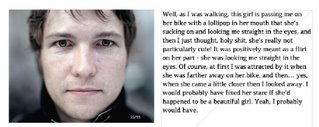
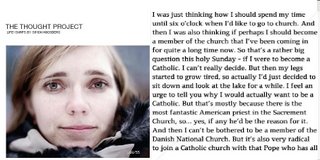
Simon Hoegsberg is the guy behind the Thought Project - a photographer, he gave himself the task of stopping ordinary folk walking the streets of Copenhagen and asking them what they were thinking about at precisely that moment. The photographs themselves are gorgeous; even better, though, is the fact that most of the people he stops are sweet, complex, articulate souls who open up, just for a moment, a doorway into their minds and lives. All through a few words. Take this one:
... you can read the rest of this (and the many others) at Hoegsberg's website.
I had a lot (LOT) more written, which I've just lost. That's how the internet and me get along, I guess. I'll try to re-write it tomorrow, or not.
Sometimes I wake to find questions crowding in like cats batting their angry paws at my bedroom door. I usually realise quite quickly that what I have taken to be questions are, in fact, cats batting their angry paws at my bedroom door, but I find the easiest way to ignore this kind of feline spam mail is to imagine that they are questions, rather than hungry and irksome creatures over whom I have some responsibility. And so I retreat to an idyllic corner of my mind (I call it "Christopher Walken's House of Pantaloons") and ponder these queries, which are to me a kind of frog chorus.
For instance.
DOES EVERYONE YOU EVER KNOW READ THE SUNDAY PAPER?
It would seem so, yes.
WHERE HAVE YOU BEEN? YOU NEVER FINISHED YOUR ARTS FESTIVAL WRAP UP.
I know. There were a few shows I didn't get to mention (Mantalk, La Clique) but they weren't traffic-stoppers so I don't feel too guilty. Also: Cairns.
WHY WERE YOU IN CAIRNS?
I cannot say. But if it were a James Bond film, it would most decidely have been one of the early 70s ones, since it involved a contraption which looked like this:
It also involved a man explaining to me the finer points of cognac appreciation, an afternoon in an open air spa with cocktails and lovely ladies, fast boats, scuzzy underwater photography and, well, Cairns. So definitely a 70s number.
WHAT ELSE DID YOU DO?
I accidentally licked an old lady's finger while trying to lick an ant. I swam in a watering hole with a turtle. I was introduced to a kind of fruit which weighs about 50 kilos. And I ate more food than I really should have.
WAS IT FUN?
Mostly. Almost entirely. Here's an image-based approximation of my feelings over the whole trip.
IS IT TRUE THAT ONE IS STILL WHAT ONE IS GOING TO CEASE TO BE AND ALREADY WHAT ONE IS GOING TO BECOME? THAT ONE LIVES ONE'S DEATH, AND DIES ONE'S LIFE?
This is a watering hole.
HOW'S THE NEW HOUSE GOING?
Great guns. I now sit of an evening upon my grand balcony, gazing through smug, half-lidded eyes at the glory that is my dominion. Or at least the park opposite. Also they make good coffee on the corner.
CAN WE ALL COME AND SIT ON THE BALCONY?
Of course, it'll be a grand old time and we can toast future happiness and tell tall tales and also just more ordinary stories too (not tall).
TELL US A STORY, OH WISE ONE.
Well, I recently heard a story from someone who, as a child, was quite the enterpreneur. She grew up in Hong Kong and was intrigued by the economies of scale involved in the whole tooth-under-the-pillow thing. At a local feast, she found some pigeon's heads discarded after a cook-up, and figured that a beak was worth at least a few teeth. A week later her parents complained to the housekeeper about the godawful smell coming from her room, and it didn't take long before somebody lifted her pillow to reveal the little row of bird heads festering underneath.
Huh. Kids.
CAN YOU RECOMMEND A GOOD BOOK?
I'm reading Bulgakov's The Master and Margarita right now, and it's very, very good.
HEY WHILE WE'RE HERE, CAN WE BORROW SOME MONEY?
What, so you can blow it all again, like last time? Geez, is that the only reason you came over? I'm not a cash machine.
WE WERE JUST ASKING.
Well if that's all I am, fine. But I don't have time for your stupid panhandling; here I am holding down a full-time gig, fending off the creditors and jetting up and down the coast, while spending the rest of my time with my forehead pressed against the steering wheel of the '78 Falcon I bought thinking it would give my life "vim", listening to Harry Nilsson's Without You on repeat and wondering exactly what would happen if I just closed my eyes and floored it. Basically, I'm really busy.
WHAT DO YOU WANT FROM US?
Nothing! I just want to sit here out on my balcony, reminiscing about tropical Far North Queensland and ignoring your stupid scratching at my door. Is that too much to ask? So quit your mewling and let me get back to getting back. Oh wait.
My voice is the first thing to go. If you want to give me a 100-point check-up, the way a mechanic would sort out a car's current state of being (but at a mere fraction of the cost!), I suggest you listen for the rattles and whines. I can go for long stretches coasting down life's highways with nary a shudder, but I'm pretty sure my vocal register acts as an index to what's going on under the bonnet. Maybe it's just me.
For someone with so little control over that register, however, I've found over the years that other's voices really stick with me. I used to delude myself into thinking I had a good memory for names, and when that proved wrong I went for the obvious "faces" option, but really, it's turned out that I have no particular facility for remembering either. Voices, on the other hand, I do recall rather well. If I think of someone I once knew, I can always summon up their voice. Can everyone do this? I hope so. I can imagine that, in our visual/textual culture, when we think of another person we rarely do so by conjuring their sound. If you're like me, though, and find it pleasurable to drag a memory out of the old toybox and enjoy it for itself, passing it from hand to hand, feeling its weight and the way gravity pulls at it, you could do worse than trying this kind of recollection on the aural level. If you know me, try to recall my voice.
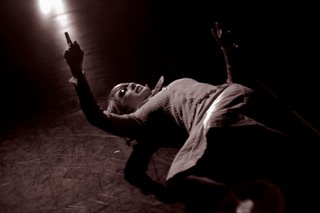
Two of the shows I've enjoyed most during this year's festival have been dependent on the power of one person's voice. They're vastly different pieces, but each offered a sole speaker throwing words into the void, hoping that they would find some purchase.
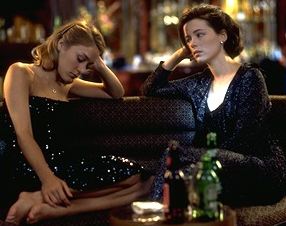
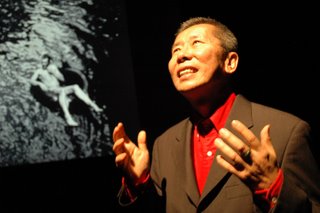
William Yang's Objects for Meditation sounds as dry as can be, on paper at least. One guy standing alone on a stage, talking for an hour and a half about, well, stuff, while twinned projector screens behind him are filled with photographic images illustrating said stuff. It works, though. Yang is a charming orator, speaking in a very emphatic, slow style, and taking us on an eclectic oral journey encompassing decades of his life, his travels, his sexuality, his family, his pseudo-Daoist philosophy and the relationships between all of these things. It's an artfully artless performance, seeming on the surface to consist of little more than the peripatetic ramblings of a worldly (and wordy) soul, but hinting at great correspondences between the various aspects of a person's existence. It's also a very humble work; describing his attraction towards water, he sums this up well. Water seeks out the lowest places, but it carves its way through mountains. Water's softness slowly defeats hardness.
There's a great deal to ponder over in the narration, and it's the kind of piece that slowly settles into your mind over a while, well after the show has ended. It kind of reminded me of W. G. Sebald's writing, which I've never felt I truly understood, but which nonetheless gets my mind going in all kinds of directions. Which, I suppose, is a kind of understanding in itself.
Yang's an engaging speaker, but not quite engrossing. Marie Brassard, on the other hand...
Brassard's Peepshow really is my festival pick for 2006. I didn't go in with particularly high expectations, since the idea of a solo show that boasts a performer whose voice is electronically altered screamed 1979 performance art nightmare. How wrong I was. Brassard is an actor who holds her audience in the palm of her hand, but uses that power conscientiously. She takes us to places we might not be comfortable with (and god knows, her climactic thigh-carving bit is an exercise in Deleuzian panic-button-pushing) but also offers a shag-pile carpet to fall back onto when all's said and done.
Well, all might be said, but it's never done; not if a show is worth it. Peepshow is worth it. If you only see one show this fest, make this the one. If not: sorry. Come back next week to read more.
I've been asked by the irrepressible Ausculture Jess to post on a matter dear to my heart, about which she has been subjected to countless rants (well, one, and it wasn't very rant-like, and only lasted about a minute) and of which she would like to read more in a textual online form, since this will make it authoritative and quotable and perhaps true. Be warned, however: Jess does live in a barn and is periodically attacked by cats of various sizes who may or may not be under my mental control. She's moving out of the barn soon, though.
So: today's lesson is a quick primer in the subject of Historical Disco. Not disco which has been imbued with an historical patina now that we're several decades on from that colourful era of the late 70s and early 80s; no-no, sweet silly children, how innocent you all are! Take your places, now, and ready your notebooks. Afterwards, if you are good, there will be singing.
Disco was much reviled during its heyday, and its often bland excesses and vacuous hedonism leading, among other things, to the rise of seemingly-antithetical musical genres such as punk, mainstream metal and 80s white bloke rock. A rise of music which offered an antidote to disco wasn't just a taste thing, however, since it played upon a rich vein of social tensions only hinted at in the overt rhetoric. For many, disco was a feminine realm (and by implication, feminising, since it's always been ok for chicks to boogie, but John Travolta's uplit white-suited gyrations just ain't on, man). The hairy rock of Bruce Springsteen or the frenetic pogo-ing of Pistols fans didn't upset the boundaries: no chance of a guy being misconstrued, is all I'm saying.
Same with instrumentation: there's long been a divide between 'real' music (written and played by the band itself) and 'plastic' music, performed by artificial figureheads whose strings are pulled by some savvy Svengali in the studio. The issue of keepin' it real, of course, took on extra dimensions right about the time disco died, with the 'realness' of rock's talented white singer-songwriters suddenly challenged by the sample-heavy sequencer-ridden 'reality' of West Coast gangsta hip-hop.
"Disco will never be over. It will always live in our hearts and minds. Oh, for a few years, maybe for many years, it will be considered passe and ridiculous. It will be misrepresented and caricatured and sneered at. People will laugh about John Travolta, white polyester suits and platform shoes . . . Those who didn't understand will never understand. Disco was much more and much better than all that."
Impassioned and entirely unironic words from the classic disco film, The Last Days of Disco (released around the same time that the atrocious Studio 54 was stinking up silver screens everywhere). But why care? Why give two bits about a dance music genre which merely gave upwardly mobile white narcissists a chance to pretend they could dance?
Historical Disco might not answer that question, but it's pretty awesome anyway.
Every genre of music has something like it, I'm sure; if not quite its mirror, at least its penumbra, that grey area which unites the mode with its opposite. Literary Rock/Pop, for instance, Kate Bush's "Wuthering Heights" or the Velvet's "Venus in Furs" spring to mind. Or that style of funk/soul dedicated to marriage and making it work, long-term.
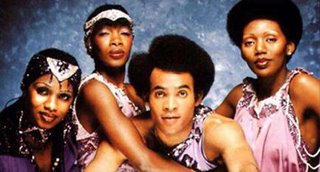
Historical Disco attempts to combine funky cheese-laden melodies with educational content, for no reason scientists have been able to discern so far. The undisputed heroes of the genre are Boney M, mainly due to three things: a) they were the creation of disco pioneer Frank Farian, who was German (Historical Disco invariably comes from Germany, b) they released not just one, but a swag of historical songs, and c) they were kind of the only group to actually record anything resembling historical disco.
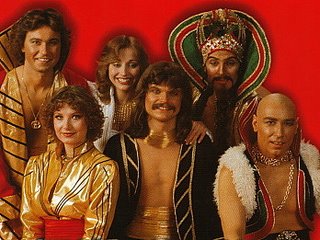
Now, I know, I know, this last claim is a bit dubious. After all, Dschinghis Khan's "Moskau" often competes with Boney M's "Rasputin" as the most prominent HD title. But as most people realise, while Dschinghis Khan were kind of historical (if you count faux fur hats and bad Russian dancing as somehow historical) the song itself is just, you know, about Moscow. Not Moscow way back when, or anything. Ok, sure, you do get the line "City of mystery/So full of history". I guess I'll pay that. And they did possess what might well be the best stylist in the history of any form of music, anywhere, ever. I draw your attention to Exhibit A.
But "Rasputin" is a beast of a different character.
Consider the finely wrought lines of just a sample stanza, and see how they take dry textbook material and fashion it into a thing of great beauty:
"This man's just got to go!" declared his enemies But the ladies begged "Don't you try to do it, please" No doubt this Rasputin had lots of hidden charms Though he was a brute they just fell into his arms Then one night some men of higher standing Set a trap, they're not to blame "Come to visit us" they kept demanding And he really came
Now, Boney M. were obviously as familiar with history as they were with things like syntax, cadence and meter, but they could sure slap some multi-layered vocals over a jumping bassline.
Farian put the band together after he'd scored a solo hit under the Boney M name; not exactly being of model looks, he decided to bring in four dancers, two of whom sang along on with him, and two of whom were just there for visual interest. Interestingly, he gave this tactic another outing when he formed Milli Vanilli years later (also composed of German session musos and fronted by miming dancers).
Why he decided to turn to history we'll never know. But along with "Rasputin," Boney M pumped out "Ma Baker," "Painter Man" (about Andy Warhol), "He Was a Steppenwolf" and a few others (including religious songs about little baby Jesus and stuff). Many featured instrumentation and arranged that could be described as inspired, but 'inspired' is a short trip from 'I'm totally confused as to why my dance music is telling me things about early twentieth century Russia." And of course there's that lovely spoken word bit in the middle, in which a strange man attempting to sound like an authority but really just coming across as pissed seriously steps up to tell us that "When his drinking and his lusting and his hunger for power became known to more and more people, the demands to do something about this outrageous man became louder and louder!"
Further listening: Falco's "Rock Me Amadeus" (also in German, of course, though Austrian in origin, and more New Wave than disco); ABBA's "Waterloo" and "Fernando"; Dschingis Khan's "Dschinghis Khan" (less popular than "Moskau" but actually about an historical figure which helps) as well as other songs such as "Samurai"...uh, I can't think of any more and I'm a bit bored.
Dan Zanes plugs history to pre-teens. He's on at the Melbourne Festival this year; I saw him on Sunday and it was a pleasant experience. He didn't play any of my favourite tunes, which are the bolshie depression era work-songs or the gospelly blues laments or the sea shanty-style drinkin' songs; I mainly like these because I think it's an excellent idea for a four year-old to ask his or her mother what's the origin of lyrics like:
Take the two old parties, mister No difference in them I can see But with a farmer–labor party We could set the people free
Seriously?
What about the simplicity of:
Pay me, you owe me Pay me my money down Pay me or go to jail Pay me my money down!
Or the 13 year old kid singing:
Well it's all for me grog, me noggin’ noggin’ grog, all for me beer and tobacco. For I spent all me tin with the ladies drinking gin, Far across the western ocean I must wander.
Yes.
I interviewed Dan a little while ago and he said some stuff I liked. It's more than I expected. I'll just quote him verbatim.
When my daughter was born I had this idea in my head of what I thought everybody was listening to. I didn't know anything about parents or parenting. I didn't know anything! I grew up listening to a lot of folk music, Leadbelly, Woody Guthrie, Pete Seger and all that stuff, and I just assumed that that's the kind of music that people were playing for their kids, just updated versions of all that. And I went into the record store to get some and it seemed like everything was tied into a TV show or a movie, it just felt very corporate. Not that there's anything wrong with that, but that was all I found. And then I looked a little harder, and then there's always been great stuff for kids and families. So I eventually found lots of stuff, just not in the mainstream. But I didn't find that handmade sound that I was hearing in my head. For me, I was just trying to update Folkways Records. That was all I was really thinking about. Try and write a couple of good ones along the way, and make the kind of music that I used to hear, that made me want to play myself. That's the name of the game, if you hear something and...you know, we played down at the Andy Warhol museum last week down in Pittsburgh, and you know, when you're around something that's so good, it makes you want to do it yourself. Looking at Andy Warhol's prints just makes me want to get out some paint and just get creative in the visual realm. So I grew up listening to music that made me want to make my own music and so that's the goal really, because I don't think we make nearly as much music these days as we could be and, you know the world is not a very peaceful place and it's not a very united place. I know over here in the States there's a lot of fear and suspicion and it's a very divisive climate, and it's from the top down, really. I think music-making is the antidote to that. Music-making really brings people together. It's very social, it's very enjoyable, anybody can do it. It connects us to our past, it connects us to the stories that we can tell other people. If somebody else is connected to their culture that's different from mine then we've got something we can pass back and forth. There's just all this insanity now about this whole immigration into the US, particularly from Mexico and the South, and it's just lunacy, you know. It's created this climate of fear and suspicion and I think that, really, people are coming here with so much to share. So much culture, so much music. And I think the more we make music with each other, the more we're reminded of that. And it gives us a sense of what life can be. So people might call it kids music or something, but for me, I call it social music. Because that's the name of the game, really, it's what we do with each other. But we're at that point in America where we're not a particularly musical society anymore. But I really think that could change. You know I'm not a big complainer, I'm just sort of calling it what it is. I really believe that that can change.
The thing that got me especially excited in the beginning was going to the park. A lot of the people here that are babysitters are from the West Indies, so we'd go to the park and hang out with these West Indian women and they would teach me songs. They were pretty cool about it, they were happy that somebody was asking these questions and was interested in their culture, and I was just thrilled that they were so willing to teach them to me, so we spent a lot of time together and a bunch of them ended up forming a group, and that group is on the first record, they're called the Sandy Girls.
That made me realise that a lot of this stuff was just here for the asking, it's a cultural goldmine, and it also made me think about my own heritage. You know, if someone were to ask me about songs that I grew up with, what would I really have to say? So it got me thinking too. Like I said, I don't feel like I do enough. Hopefully the next CD we do will be a lot of songs from Latin America, Mexico on down. That's really exciting me. But every day there's new ideas. Everybody's here. I just love good music. I love great songs, I love stories. It's all around me. It makes me so insane when there's this suspicion and this feeling that we should try and keep people out or make it hard to get here, to America. These people are what's making America great!
And so on. Good dude. Not a bad show, and the kids mostly seemed to be having a swell old time. But who knows, I'm not a two-year old. And this post has gone on way too long.
It's Melb Fest interval time, since we're about halfway through, so grab a drink from the bar and elbow your way back here tout suite; we haven't got much time before the second act.
Quick review - what have we had so far? Well, we've had all manner of things, but variety hasn't exactly been the defining feature of this year's festival. In fact, the number of common elements linking shows has been surprising, seeing as how pundits were having trouble finding a 'theme' to this year's program and the festival director denied the existence of one.
If there was a theme, though, I'd say 'DREAM' pretty much sums it up. With the exception of one or two shows I haven't posted on yet, every performance I've attended has ended with me stumbling out into the auditorium rubbing knuckles in my eye sockets, blinking myself awake, and attempting to reconcile the previous hour or two with the realities of, you know, getting home. It's as if this year's festival has been calculated to turn the usual arts crowd into a horde of zombies shambling up St Kilda Rd, not groaning "BRAAAAIIIINNNNSSSS" but "AAAAAARTTTTTT". Or, in many cases, "WWWWWWTTTTTFFFFFFFF?"
Tonight I saw Japanese dance company Fluid hug hug's Rise:Rose, and as I watch my memories of the event rapidly recede in the rearview mirror I'm compelled to write something about the event. It featured three terribly adept dancers pulling every move possible, it seemed. The sparseness and control of traditional Japanese dance was tempered by the fluidity of contemporary practice, and even hip hop elements crept in with hand plants and subtle popping. But though there's no denying the skill of the dancers (amongst the best I've seen this year), it was one of those shows where I had no idea what was going through the choreographer's head when he put it together. Why this move, and not that? What's this sequence dealing with? What the hell is going on?
This confusion, mingled with the obvious abilities being showcased, put me into the state that's been the recurring theme of the festival, that dream-state I mentioned earlier. It's not sleep, exactly, but it's certainly a reduction in the beta waves, to get technical, and a major upping of the theta cycle.
It's as if these shows are designed to put you into that state where you're not quite asleep yet, but are ready to dream. As my plus-1 put it tonight, it's that moment where you're lying in bed thinking about stuff, with music playing softly in the background, and suddenly you snap to and realise there's no music playing. Or, as he put it more succinctly, "I feel a long way away from my feet."
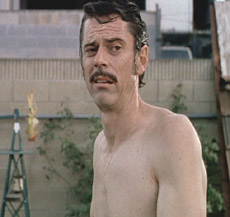
I've been feeling that for a while, and I'm hoping to find a show that puts my feet squarely back in the picture. Not that I haven't been enjoying the festival so far, or that my feet are a pretty addition to any picture, but as the fat sheriff in the cult 1971 film Two-Lane Blacktop puts it:
"If I'm not grounded pretty soon, I'm gonna go into orbit."
Back when I was a teenager with bad hair, poor social skills and no dress sense, long before I became an adult with poor hair, bad dress sense and no social skills, I had what is known as “potential.” I suppose the downside of “potential” is that it usually leads to “potential squandered,” but there were at least a good few months there when people were willing to give that kid a chance, because they thought they saw something glimmering beneath the surface, a diamond-glint amongst the clay, and they felt the sudden urge to throw caution to the wind and take a gamble on some chump who might not have great hair, or dress sense, or social skills, but by gum he’s got that something. And maybe they were drunk.
Of course, as a teenager, I was also only dimly aware that things had actually happened before I was born (wars and perhaps dinosaurs, if my education serves me correctly). But history has a way of running up and punching you in the goolies, as I found out too infrequently.
At about 17 or 18 I was asked to perform in a play commemorating an historical moment in the history of Warrandyte, a small town on the Victorian coast. The event in question was the collapse of coal mine many decades ago; I played a young miner, Bert, who was trapped in the collapse alongside the many who died from the disaster. The play was nothing special, dramatically, but it had a major significance to many of the elderly townsfolk who recalled the incident from their childhood. And as I was leaving the auditorium a man of perhaps 80 stepped towards me and introduced himself. “I’m Bert,” he said in embarrassment. “I was you.”
It’s hard to say what responsibility a director has when dealing with a real historical catastrophe, especially when those who survived are still alive. These are the problems Lucy Guerin has faced with her latest work, Structure and Sadness, presented as part of the Melbourne Fest. Her show is dedicated to the workers who died in the collapse of the West Gate Bridge in 1970, but the show itself isn’t a dedication, or a recreation. It’s something more, and I think it’s a works.
Creating a dance piece centred on a real tragedy is a big ask, and Guerin has made a wise choice, I think, in going for an impressionistic response rather than a literal one. The work tries to evoke both the physical forces at play in the construction of massive structures as well as the human response to great calamity. I think it succeeds.
It’s hard to be objective about the end result since I’ve been following it for some time now (I was even thanked in the program, to my surprise). But having spoken to some of the people involved in the bridge’s collapse way back when, I think they’d be proud of the result. I hope that none of the dancers have a Bert moment. But it’s a pretty powerful moment to have, and I think that their Bert would have shed a tear during the show.
For some reason I had trouble hustling up a willing companion to accompany me to Robert Wilson’s A La Galaga. Why? The question really beat the urine out of me. I mean, here we have the chance to see a work by one of the world’s leading directors, arguably the world’s premier director of contemporary opera. The guy made Einstein on the Beach, which has surely earned its place in the pantheon of “on the” artworks (Kafka on the Shore, Fiddler on the Roof, Blame it on the Boogie). Sure, come the naysayers, it’s three hours long with no interval.
But look at the title! It’s Wilson doing Galaga! How can this be wrong? If I heard that they were touring Peter Brooks’ After Super Mario or Robert Lepage’s Eight Airs in the Key of Pong or, hell, even Barrie Kosky’s overrated The Insatiable Man of Pac, I’d be jumping onto the back of the couch, sending my dinner ($3 microwavable nachos from 7-11) arcing across the room to Pollock the wall, yelling at the top of my lungs something like “get me Ticketmaster on the dog-and-bone ANON!” before collapsing in a giddy heap and coming to in a congealing puddle of room-temperature salsa and not-quite-cheese as the realisation struck me Bruce-Lee-double-punch-style: I have no one to make such calls for me, and perhaps there’s a reason for that. But it’s Galaga!
As a kid, I’ll admit, I hardly acted honourably during the whole Galaga/Space Invaders civil war which fractured the globe during the early 80s; I was the double agent, the lad who’d spit coins at any flashy number that came my way. I’d heard the propaganda: that the big G was just a cheap rip-off; that Space Invaders was the only ‘pure’ way, and that anything else would only lead to a life of sordid squalor and Russell Street arcade hanging out in-ing. But I didn’t care: give me bleeps and squiggles, blinking lights and ever-rapidly descending aliens, hope and loss for 20 cents a pop – I’d gladly get it wherever I could.
Three hours of Galaga? Nothing. Even as a twenty year old, after a decade hiatus, when I found a vintage Galaga machine at the old International Bar (now Ding Dong) in the city, I rediscovered my lack of ability but abundance of optimism in the game, frantically mashing those random buttons in the belief that I could stave off global annihilation for far less than the cost of a beer. And I found this through the wealth of friends and strangers who were eager to challenge me at that very same task.
Three hours of Galaga? That was just a warm up for us.
So where were these gallant button-jockeys now? Where were those looking to see their teen computer game addictions played out on Melbourne’s largest stage, by a director at the top of his game?
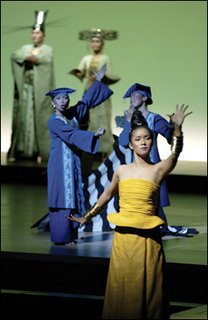
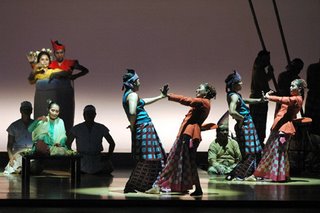
They were reading the program more closely, it seems. As it turns out, Wilson’s epic is titled I La Galigo, and it’s his rendition of an Indonesian creation myth that rivals The Odyssey in length and impact.
I found a friend, finally; D_____ was a frequent visitor to Indonesia in his youth, and knew enough of the language and culture to educate me well before and after the show.
Which was, itself, like a lot (if not all) of the festival as I’ve seen it so far. The best word I can find to sum it up is: interesting. Yeah, hardly a word that will have you cussing yourself for not booking tickets earlier, but that’s how it’s been. There’s been nothing that I’d rave to my friends about, and insist that they MUST see, but there’s been nothing that I’ve been tempted to walk out of, either. It’s all been rather intriguing, quite original, somewhat different, nicely produced and adequately attended.
Interesting.
Wilson’s saga is three hours, yeah. And it could be cut, I suppose. The initial sequence of performers walking slowly across the stage bearing traditional Indonesian artefacts as the onstage band plays distantly, not too dramatically, wasn’t an instant turn-off but felt unnecessary. Once the actual story itself kicked in, at least half an hour on, it proved fairly compelling, in the way that most creation myths are. There was war, prophecy, divine intervention, exploration, wonder, sex. The usual. And Wilson did a good job making the thing pretty pretty, though not super-pretty (I know his thing is making the backdrop lighting impressive, but he needs to expand the palette).
And the venue. We were obliquely notified that we were free to enter and leave the auditorium throughout the performance, in keeping with the fashion of Indonesian theatre. And god knows, at three hours, throughout an epic creation myth mostly conveyed without words, this would seem appropriate.
But we were at the Arts Centre, for a Melbourne International Arts Festival show, so the young couple immediately to my right were subjected to about 80 Sharp And Disapproving Glances by the older couple in front of me, as they giggled and talked during the first ten minutes (they walked out after that). Others occasionally spoke in hushed tones, but there was the generally stultifying air of a High Art performance throughout.
Which is fine, in context. But this show didn’t deserve such a context.
It deserved a showing in an open-air amphitheatre, with a large crowd coming and going, talking, commenting on and drawing thoughts from the goings-on onstage. It wasn’t a show for breathlessly absorbing: it was a show for engaging with, in the full sense of the word, for being a part of, in the way that audiences are so rarely these days. It should have been the Galaga experience, in which every paying audience member felt a vital and immediate connection with the story being told and the many people who are telling it.
It was, however, interesting.
NB: If anyone wants to produce a show with all the interactive energy of an old-school video game, I’m right behind you. I imagine a Bosch-style mise-en-scene with dozens of actors onstage, each tethered by marionette strings which are controlled by an individual audience member. The audience, then, creates the performance we see, and its up to our creativity in conjunction with the performance abilities of the cast to make something wonderful. Perhaps impractical, though.
I am a very good audience. I am perfectly willing to sit motionless for hours at a time, watching something I'm only half enjoying. I will gladly sacrifice both armrests. I can uncross and recross my legs in absolute silence, or shift my body weight without a creak, and without rocking the seat of the poor fool in front of me. I try to sit as low in my chair as possible so as to maximise the sightlines of the people behind. I attempt to breathe inaudibly.
The Castellucci show I wrote about yesterday was performed, as far as I recall, in near silence. To be honest, I don't remember if there was music involved; I think there was some sound during the scene changes, but it was the kind of show you don't remember clearly. There was sound from the actions onstage, obviously. But there were also long, long periods where you could have heard the proverbial pin. I guess the reason I don't remember whether or not recorded sound was laid on top was due to that old John Cage dictum about the myth of silence, about how there's always sound, especially when you have an audience. Audiences make sound, and this is part of the performance, too, or at least the 'event' of which a performance is only one part. I love audiences; I loved it when a little boy behind me spoke up during a quiet bit in Warby's Monumental to tell his mother that he was hungry. Me too, kid!
But the chilled hush during the Castellucci piece was broken, for me, by a far more testing sound. At some indefinable point, the dude to my left began breathing loudly through his nose, and sounded sort of sinusy and blocked up, so I was watching the onstage proceedings with a soundtrack that sounded like a wheezing, desolate wind blowing across a craggy moor. Wheeeeeeeze. Pause. Wheeeeeeeeeeeze. Pause. Wheeeeeee- you get the picture.
And then a funny thing happened. The woman to my right picked up the beat, and began wheeeeeeezing in syncopation. Suddenly I was in the aural equivalent of a tennis match played by two lumbering giants with a bad case of the sniffles.
Hrriiiiiiiiisssssllllzzzzzzz....
Tssssniiiigggghhhhhhuuuuuuhhhhhh.....
Hrriiiiiiiiisssssllllzzzzzzz....
Tssssniiiigggghhhhhhuuuuuuhhhhhhk!
Oh well.
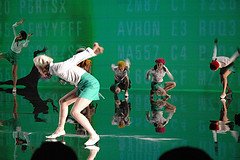
Not much room for quiet when last night's Voyage started up. Instead, the cataclysmic roar that Japan's dumb type do best, the kind that resonates at such thunderous and low frequencies that it feels as if every atom in your body is being shaken violently and you might just begin to disintegrate if it keeps up much longer.
How was the show? Well, hard to say. I think my +1 for the night put it best: afterwards, she said that during much of the performance, she was asking herself "do I like this or not?" And we both agreed that the question sort of became irrelevant after a while. It wasn't a show you liked, or cared about, or anything. It was a very similar experience to the one I had when I last saw the same group, about two years ago, I think. I vividly remember being struck by several moments in that show, but the rest of it is just a hazy, dream-like memory. Same thing last night. You emerge from the theatre rubbing your eyes, waking up and already feeling the experience starting to slip from your conscious mind into some dark crannies of your forgettory.
The group mix tech-heavy multimedia such as microscopic cameras, electronic soundscapes and carefully controlled lightshows and projections with contemporary movement: sometimes dance, but sometimes stretching the dance vocabulary to such an extent that the word doesn't really apply. The sequence of scenes presented had a few loose connecting themes, mainly to do with voyaging, air and space travel, and diasporic experience, but it was more often an impenetrable logic that structured the subject matter; often thematics seemed sidelined by the pure theatricality of the moment, an arm arced in a particular fashion reason enough for its own existence. Overall, even with the body-shaking score which sometimes erupted, the overall thing seemed carefully constructed in order to put you into a different state of attention, one where a small part of your brain was taking in the sights on offer and doing a little bit of meaning-making, while the other, less literal parts where sent of a voyage of their own, given licence to take flight and take you far away from a little seat in a large, darkened room. Coming back was a bit like stepping off a plane, the unfocused eyes and difficulty speaking and sense of soul-lag there as well. So, I wouldn't say that I liked the show, or that I'd necessarily want to recommend it. But I sure had a good trip, and some pretty vivid dreams when I finally went to sleep.