Wednesday, August 15, 2007

MIFF report 8: End of Story

OK, so I'm a little late in posting my final MIFF bit but the Closing Night party which I hadn't meant to attend but ended up going to at 1am wearing a drawn on moustache along with a gaggle of odd friends took a little wind out of my sails, and I was worried I wouldn't be able to write long, rambling sentences for some time. Clearly, a concern I needn't have had. So I'll quickly wrap up the few films I haven't discussed yet:


AFTER THE WEDDING


After the Wedding was the last film I saw for the festival, and I quite enjoyed it. A Danish post-dogme drama, it stars Mads Mikkelsen who is fast becoming one of my favourite actors. Here's a quick run-down of the plot.


OMG I'm totally in India running an orphanage (probably going to heaven for this) WAIT *ring ring*


Hi Mads it's your boss you have to go back to Denmark.


No DENMARK SUX!


No you have to go


No I said DENMARK SUX perhaps you didn't hear me properly and also you were much older in the movie


Yes but there are no pics of me on the internet


Right-o


SO you have to go because a dude wants to give us heaps of dollars or maybe kroner I guess for the orphanage


DAMN ok brb
whoosh


you are my man now dog!


great can I have my money


all in good time my dear chap all in good time


DAMN ok


hey also come to my daughters wedding


DOUBLE DAMN but also ok


*wedding music* I am the rich guy's daughter lol


jolly good I'm off WAIT A-


heeey


heeey


heeey


heeey how you doing


i see you've met my wife


WOOOAAAAHHH

*cut forward through lots of drama*


MADS: well that was a lot of drama that just happened right there just then, it was very exciting

WIFE: yeah full on, also I look a bit like Princess Mary in this movie

MADS: awesome

WIFE: yes but really we probably couldn't fit any more drama into the film


WAIT PLOT TWIST .... ZIIIIING!


omg nobody saw that coming, well they did but it was still pretty full on and riveting. look I'm sweating (a bit)

I give it a sizeable number of stars out of a rating system based on a slightly larger number of stars


ISLAND OF LOST SOULS


Continuing my Danish theme, I saw this kids' flick from Denmark earlier in the day. It's pretty decent and has some great CGI effects - think crackling electricity bolts and crazy shadow creatures and stuff - and if you've got kids it should give the little Potter-heads the quick fix they're probably slavering for right now. It's definitely a kids number though - hardly even a "family film" since the plotting is a bit lame and full of holes and doesn't make a helluva lot of sense.

In the 1890s some necromancer was killed by a secret brotherhood called The Lodge for Combating Evil (that was actually pretty funny in the film) and now obviously all the Lodge members are dead. Cut to today where a little girl is being annoyed by her twerp brother who quick-smart gets possessed by one of the old Lodge members. Turns out the evil necromancer is back and living on a nearby island and we badly need a bunch of perky brats to sort things out pronto. Our heroine and her possessed brother join up with another local kid and the small country town's resident paranormal investigator (I know country Denmark and to be honest, that's not as far fetched as it sounds).

Then it's off to the island and lots of hijinx and whatnot involving an animated killer scarecrow and souls in jars and the evil necromancer who now has wisely added "bald and glowing eyed" to his already impressive job title.


As the program notes suggested, the director clearly knows his Spielberg, right down to the I-can't-believe-it's-not-John-Williams soundtrack. There are enough quirky flourishes to maintain interest - having one main character as a possessed kid is pretty weird - but it doesn't quite have the grandeur it should, or quite enough plot elements adding up to something truly epic and original. Like I said, though, a fun flick for kids - though the aforementioned scarecrow was pretty scary, and had at least one tyke in front of me immediately running from his seat to mum's lap where he sat covering his eyes for a few minutes.


A MAN VANISHES


This is a really important film of its era, but sometimes that isn't enough. For me, it was the most boring film of the festival and while I know it's important, so was the state of my rear after two and a half weeks of films and I couldn't handle what this flick was doing to it.

The 60s documentary takes as its subject the phenomenon of people who simply disappear from society for whatever reason. It starts with the case of a guy who vanished and I quickly found I could relate as my interest, patience and caring soon went AWOL too. The film tracks various people who knew him, soliciting their opinions as to why he'd do it, and continues in this vein for a few hours. Then it gets bogged down with his fiance and her sister who start arguing about whether or not he'd gone to the sister's place a few times. This argument continues for at least twenty minutes, I swear. Now, I gradually became aware that this "documentary" was in fact mostly fictional, since everything I'd ever read or heard about it told me so, and so I was wondering why exactly I was being subjected to this looooooong, pointless and circular argument. I swear to you, it went nowhere, and didn't even go there in an interesting way. It was like two people saying "you did" followed by "no I didn't" on repeat for twenty minutes. No wait, not like that. IT WAS THAT. With tiny, minor variations.

AND THEN SUDDENLY THE DIRECTOR APPEARS!


The set gets pulled back and he explains that this is all just fiction.

I almost expected him to wink at the camera and put one finger to his lips in a "shhhh" gesture as the film froze and faded to black.

I wish.

Nope, instead we return to the drama where the actors go out on the street and continue THE SAME ARGUMENT for another ten minutes.

Unlike the film, however, I won't keep you here any longer.


P.S.


MIFF was the best I've seen in years. Congrats to all involved. I had a hearty good time.

And I just realised I wrote more than 10,000 words on this here blog during the fest.

Wednesday, August 08, 2007

MIFF report 7 - More than MIFF

What's all this malarkey about text shrinking in my posts? I have no idea. It doesn't happen on any of the computers I'm using. Maybe it's a Firefox thing or a Mac issue or whatever. I don't get this stuff.

LONDON TO BRIGHTON


About a year ago I was in England and on my last day overseas before flying home I decided to visit Stonehenge, because I hadn’t been there and apparently the Big Rock craze which swept the country some time ago left some mighty monoliths worth a look-see. Enlisting the two friends I had remaining in the country, we hired a car and drove through the countryside to see the chunky fellas. After our sight-seeing was done, we decided to visit nearby Avesbury, but got lost due to a strange number of army tanks and armoured personnel carriers which were buzzing all over the area and realised we had no idea where Avesbury was (or why there was a full scale military operation seemingly going on around us). On a whim, we decided to drive to the lovely seaside town of Brighton instead.

The problem with this brilliant plan was that we had no maps, no money and none of us had ever been to Brighton, which was clearly a long way away. On the bright side, we had a small compass embedded in the wristband of our driver and the worldly knowledge that Brighton is along the southern coast of England. So we figured if we just drove south and then followed the coastline, we’d be there in a jiffy.

Five or six hours later we arrived in what might be charitably termed a state of blubbering droolitude. A nice meal and some cavorting along the rocky beach next to the famous Brighton Pier helped soothed the nerves, and when the sun had set we drove back from Brighton to London, and collapsed in preparation for the flight the next day (the hire car was towed while we slept – true story).

And so I have to admit that the only reason I went along to the UK film London to Brighton was to relive that exhausted but somehow jubilant commute in reverse. It was the end of my journey, after all, and that always carries some kind of melancholy charge.

I didn’t realise that the reverse trip, in this film, would turn out to be a one-way ride with terror the final destination! I know, I know, I’ve always secretly hoped to be the copywriter for shitty B-grade flicks.

London to Brighton is a puerile, tawdry monster of a piece crafted with impeccable skill. A prostitute is ordered by her pimp to secure the services of an 11-year-old to satisfy the sick desires of a wealthy businessman, and after finding a sassy pre-teen the deal gets bloody and she soon finds herself on the run with the kid, hotfooting it to Brighton. Meanwhile, the shotgun-toting pimp along with the businessman’s psycho son are hunting the two down to exact bloody vengeance. It’s all much more tasteful than it sounds.

No, wait.

It’s jaw-clenching, squirm-in-your-seat fare, and it’s certainly well-executed, but the whole paedophilia angle had me horrified from at least the first ten minutes onwards. My point here follows on from my last review: at what point does playing on the real terrors which exist in society become just another excuse for entertainment, giving us a thrill of abjection that is finally satisfied by the demands of your typical filmic narrative? Films demand resolution, after all, and while I exited London to Brighton aware that equally monstrous stuff is going on all the time, the distance I felt from the fictional characters I was offered, as well as the seedy settings they inhabited, meant that I didn’t feel I’d witnessed something that would change my world. And given the subject matter, it should have.


CRIMINOLOGY


Tonight I headed along to the opening of Malthouse Theatre’s Criminology. Like London to Brighton, it deals with some scary stuff, but unlike that film it doesn’t just explore the things we normally ignore, but actually engages with a true case of horror. In 1997, a Canberra law student drugged her boyfriend and injected him with enough heroin to kill him, intending to end her own life afterwards. All of this occurred after a party at which most of the guests knew her mission.

Criminology doesn’t re-enact the case but instead re-imagines it, drawing on the talents of playwrights Tom Wright and Lally Katz to get into the minds not of the woman in question but of anyone who could commit such an act. It’s a bizarre mixture of social realism and warped fabulism. I’m still thinking about it and so I won’t write a proper review here – I’ll be writing plenty about it elsewhere. It’s definitely something worth checking out, however, especially if you had any kind of interaction with culture in the late 90s, since the soundtrack, cultural references, clothing and even set design are eerily evocative of that period which, even though it’s only a decade gone, sometimes seem a lifetime past.

And of course if frequent explicit sex, nudity, heavy drug use and strobe lighting is your thing, they’ll be throwing you a bone as well.


THE JAMMED


I saw a preview of this film early this week. 10am on a Tuesday. I haven’t looked at Melbourne the same way since.

It’s having a short release from August 16 at Cinema Nova, though I think it should be receiving a much bigger release.

The big distributors didn’t want to touch it. It didn’t make it into MIFF, though it sold out at the Sydney Film Festival.

It’s a drama about the slave trafficking industry in Melbourne.

It’s based on real testimonials and court transcripts. It’s also an exquisitely crafted thriller.

There are flaws, sure, but compared to the usual Aussie output – from gangland dramas to giant-croc horrors to outback romances – it’s in a league of its own. It’s been years, easily, since an Australian film has moved me to such teary-eyed anger.

I think you should see it.

Sunday, August 05, 2007

MIFF report 6 - Movies You Either Won't Have a Chance or Shouldn't Bother Seeing

MEN AT WORK


Men at Work
is the definitive film about four middle-aged Iranian dudes trying to push a rock off a cliff. I’ve always felt the whole Guys Pushing Rocks Off Cliffs sub-genre has been under-represented by the Melbourne Film Festival, so the fact that this film was included was a bonus, but it’s actually better than it sounds.

A car-load of mostly bearded geezers are on their way home from a ski trip and notice a ten foot tall stone pillar sticking out of a bend in the road and ready to topple down into the lake below, and here’s where the audience is divided. I did a random sample survey of my male friends after the film, and most agreed that it’s a natural human instinct to give the thing a push. If you’re the sort who’d keep on driving, skip to the next review because there’s not much else in this film for you. For everyone else, though, you’ll be subtly engrossed by the escalating drama of this quartet as their initially whimsical attempts to knock the thing over become a mildly obsessed quest to finish what they’ve begun, as tools are secured, reinforcements called in and relationships are put to the test.

It’s a deliberately underplayed film that is more concerned with character than situation, and as various strangers, partners and work colleagues are drawn into the struggle we gain a pretty compelling portrait of masculinity and its shortcomings. After one of the guys is injured the crew drop the rock-toppling thing and head back to town in the fading sunlight, but one decides to persevere and do whatever it takes to bring the rock down. The film’s ending is a tiny tragedy in its obvious inevitability, but also a quiet triumph in the way it suggests hope despite the ridiculousness of these fellas’ macho aspirations. Highly recommended, though I don’t think it’s screening again.


BUG


Bug
was based on a play, which usually means it was really, really cheap to make. You’ve got a script right there, and you probably only need to shoot in one or two locations at most. You’ve also likely got a small cast, since professional theatre pays its actors and rarely has much money to flash around on minor parts.

I spent half a decade studying cinema theory and my academically qualified assessment of this flick is that it’s really, really stupid. I’m still a little cautious in advancing such an damning appraisal as I clearly wasn’t any more clever than anyone actually involved in making the damned thing, since I actually sat through the whole film.

Ashley Judd plays the central character in a white-trash triumvirate, a seedy motel-dwelling hick who is being stalked by her ex-con ex-husband and courted by a creepy young guy with bug issues. It all comes to a heated confrontation as ex-husband takes on creepy new dude and is taught a valuable lesson about the perils of stalking your white trash ex-wife, and then a pointless and unjustified final act sees Judd and her new beau descending into a maelstrom of paranoia and bug-fear and aluminium-foil wallpaper that curiously manages to be both puzzling and sleep-inducing.

Judd’s former hubby is played Harry Connick Jr, who here continues a bewildering streak of film roles in which he plays foul-mouthed hillbillies with murder on their mind. I do appreciate how his cinematic career thusly distinguishes him from the Connick Jr of music, since his albums have always been solidly targeted towards middle-aged couples looking to rekindle the romance of their youth and hunting for the perfect soundtrack to accompany a candle-lit roast, some cheek-to-cheek on the back verandah and a quiet thank you to God that the old folks were willing to mind to kids for the weekend. He might not be an artist I have any interest in, but he plays a valuable social role for someone, I guess.

Here, though, he joins his cast in what we call an “actor’s film”. This usually means that he is given free reign to indulge in whatever expressive melodramatics he desires, and he’s surprisingly restrained in comparison to the others. Much of this flick is someone or other screaming, crying, eye-rolling, yelling, punching walls, scratching furiously, projecting delusions or otherwise boring their audience in some way or another. An actor’s film, unfortunately, is rarely an audience’s film.


CHILDREN


There’s no real point to Children, either, but it’s a hell of a lot more enjoyable. It’s an Icelandic character piece that is well-cast and well-acted and well-good. An ensemble number, it shifts between the fortunes of a diverse group of loosely connected folk – a young mother of four living in a council flat, her rebellious teenage son, his violent and thuggish father, estranged until now, and the schizophrenic man who is the poor kid’s only friend. It’s shot in black and white but doesn’t have any of the trappings of self-absorbed arthouse fare, instead creating a psychological realism that is heightened by the fascinating characters on offer.

If Ken Loach took a quick (if expensive) Iceland Express flight north and slapped together a film on a weekend off, you might end up with something like this. It's a deliberately paced work that superbly balances social realism with narrative intent, convincing characters dragging you into their conflicting worlds. As the harrowed young mother Karitas, Nína Dögg Filippusdóttir is unforgettable, and worth looking out for in the future. I'm not a huge fan of films like this, and it's surely not the Iceland I like to see on screen, but I thoroughly enjoyed Children from its violent, Trainspotting-like beginning to its subtly transcendent, though equally bloody end.


THE BET COLLECTOR


Manila has long overshadowed its sister-cities of Spiral Bound and Lever Arch as the Folder Capital of the World, but this long-overdue doco-drama makes an earnest and non-document-organiser-related plea, a message in a bottle that to me reads: HELP NEEDED. SEND TRIPODS. An hour and a half into the thing, my humanitarian compassion towards the plight of its central character was matched only by my hypnagogic head-nodding induced by the epileptic camera work.

The Bet Collector centres on a middle-aged woman who walks the streets of a Manila slum daily, gathering bets for the regular local games of jeuteng. Jeuteng is a kind of lottery run by various syndicates, and is as popular as it is illegal - as the film's intro states, jeuteng-related corruption is rife in the police force, the government and even the church. The last two leaders of the Phillipines have either been deposed through links to jeuteng-related activities or are under investigation.

Luckily, the film is about as familiar with judgemental attitudes as it is with proper steadicam technique, so what we end up with is an amazing portrait of ghetto life that doesn't try to pin suffering and poverty on any one target. Most of the film consists of long shots of our heroine as she wanders around the corrugated labyrinth she inhabits, touching down on dozens of locals engaged in business, funerals, arrests, prayer, escape or self-improvement before soon moving on to the next bettor. Despite the horrific circumstances the film's subjects seem to live in, they aren't treated as objects of pity, but as fierce survivors. This is a film that doesn't revel in despair, though there's a coldness to its characters' existence born purely of the pragmatic need to eat tomorrow.

Shot entirely on handheld video, it's not the easiest thing on the eyes, though. If it helps, at least I felt guilty as I was nodding off around the 60 minute mark. If this baby appears on SBS or something, though, give it a shot. Ten minutes after I was feeling drowsy, the film dragged me back into edge-of-the-seat consciousness with a riveting and perfectly staged finale.

Friday, August 03, 2007

MIFF Report 5 - World's End

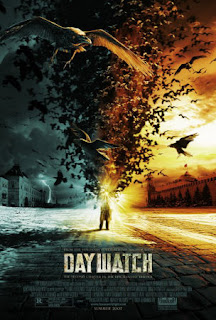
DAYWATCH


As Boney M so astutely put it: “Oh, those Russians!” Since the Cold War ended, pretty much everyone in the West has been carefully watching former Soviet states for the inevitable grudges which will still be lurking around like the smell of the rancid zharkoye your babushka left on the counter yesterday. But while capitalist swine have been suspiciously eyeing the spaces once obscured by an iron curtain, those in Russia have been busy making the kick-assing-est films ever seen!

My last run-in with a Russian mega-movie had kicked my behind so bad I was sleeping on my side for weeks. That was Nightwatch. When I heard that its sequel Daywatch would be screening this year I of course checked the bathroom cabinet for the array of rump-soothing salves and lotions I keep stocked for just such emergencies and hot-footed my way to the cinema. I won’t lie – I was wary, having been burned before by such lacklustre sequels as Porkys II, Dumb and Dumberer and the straight-to-DVD follow-up to The Little Mermaid. I’m still dealing with those.

Nothing doing here, though, since Daywatch took my reservations and cancelled them like an unscrupulous maitre d’! Does that simile make much sense? Of course not! Does Daywatch! Of course not! But it’s still the greatest cinematic event since the last really, really good cinematic event!

The story tracks the conflict between the forces of darkness and light and the factions who police the boundary – the Nightwatch and Daywatch. They’ve all got magical powers that seem to be invented whenever the story requires it or whenever it would just make for a great effect. Which is often. The film is kind of like a mystical version of The Matrix, with so much shape-changing, body-swapping, dimension-jumping and time-warping that you barely get a chance to understand who is who, let alone why they’re doing what they’re up to or why we should really care about any of it. We care because we have to, and we have to because we’re having a fantastic time and are a little bit afraid of these Russians and their superior filmmaking abilities.

If you haven’t seen Nightwatch, this film will make even less sense, but if you have seen it then know that this is an even better movie – tighter, more spectacular and full of moments that take your breath away. It expands upon the universe developed in the first film, and part of the series’ appeal (I think it’s a trilogy) lies in how it effortlessly suggests a complete alternate reality that isn’t simply encompassed within the film itself but seems to stretch outwards to the limits of the imagination. It’s a bit like Harry Potter – the Harry books aren’t particularly great in themselves, but they seem to get people excited by the way they construct an entire world separate from our own, but recognisable in all the important ways.
Here's a trailer for the film which ends with one of my favourite bits - entirely ridiculous and proudly so.


THE SIGNAL


Daywatch is far from the only apocalyptic film in this year’s festival, which is handy. Like most responsible adults, I spend a good portion of my waking life preparing for one of the various doomsday scenarios which seem increasingly inevitable, but I’m not so deluded as to think that the whole otherworldly demon angle Daywatch promotes is anything other than fantasy. No, I’m completely aware that a zombie plague is a much more likely threat, which is why I keep my one-bedroom fortified garret stockpiled with munitions, tinned food, and medical supplies. I also refrain from developing any particular relationships with other humans, since that will only make it harder to put one between the eyes of a loved one when the shit goes down, and when I wake up each afternoon I’m already repeating my self-help mantra: every day, in every way, I am getting better (at headshots).

I’m fully supportive of the new wave of zombie flicks, then (I suppose film theorists would call it nouveau undead or something equally catchy). They just help reaffirm my world view and increase my confidence in the role of paranoid loner which I have attempted to carve for myself. I was a little confused at the end of post-zom film The Signal, then, which posited a situation even I couldn’t quite make sense of. In a minor moment, some characters who’ve survived mankind's degeneration into savage killing machines do a bit of looting, which is one of the perks of any apocalypse. But their wardrobe restock seems to take place in a thrift shop. Does that make any sense? It was then that I realised how far away from my goal I really am, since clearly the only sorts who will survive a zombie outbreak are the kinds whose outfits are entirely made up of second-hand army fatigues purchased for a few bucks a pop.

The Signal is obviously quite effective horror, but it is so in more than a sartorial sense. Like 28 Days Later, its monsters aren’t shambling creeps with a bucket of ugly dumped on their heads, but are fast-moving, cunning monsters. It’s a bit like the Pulp Fiction of zombie films, too, with a fragmented narrative following a handful of characters whose interlocking destinies criss-cross throughout. Some kind of signal is being broadcast through all electronic equipment and anyone who hears it quickly loses all social censures and starts killing people in order to get whatever they want. A few folks still have ambitions beyond adding to the body count and so we watch as they attempt to escape.

Fans of zombie films will enjoy the fresh take it has on the genre, while horror fans in general will get plenty from its overall inventiveness. Those averse to blood and guts should very well avoid this, however. It’s very gory, though the central third of the film (it was directed in three parts by a trio of friends) is almost entirely comedic. The light touch provides some welcome respite from the terror, but soon enough it’s back into to the hedge clippers, power drills and decapitations.

FIDO


But zombie comedy, it seems, is all the rage. If rom-com is the accepted shorthand for romantic comedy, it shouldn't knock the yellow off your teeth when you get the pun surrounding the corporation at the centre of Fido, ZomCom. The world on offer here has survived a zombie plague by creating metal collars which subdue a zombie’s appetite for human flesh, effectively turning them into docile servants able to fulfil all of the menial tasks of society. Humans enjoy a picture-perfect life of leisure while the undead collect their garbage, serve their martinis and paint their white picket fences.

This is Pleasantville or The Stepford Wives given a zombie twist, and I really didn’t expect it to be as much fun as it is. I didn’t really grow up with the Leave It To Beaver world the film satirises, but it’s smart enough on several levels to appeal to a wide audience. Beneath the surface veneer of 1950s technicolour sterility, fertile veins of class and race are tapped – subservient zombies occupying the role of the oppressed everywhere – while an equally rich current of familial tension urges the story along. Our hero is a ten year old who finds himself dangerously sympathetic towards his new house attendant Fido (Billy Connolly) while his mother (Carrie Ann Moss) discovers in the undead manservant a caring soul more human than her neurotic and quivering husband. Meanwhile, the retired army hero next door thinks of zombies as nothing but threats waiting to be eliminated, and wants to teach the young lad just how dangerous the undead can be. It's all campy humour with an undercurrent of seriousness that hits just the right balance.


RED ROAD


It seemed odd to cast Connolly as a zombie, since this means that the comedian doesn’t actually get to utter a word of intelligible dialogue. But after watching Red Road, it kind of made sense. Set in Glasgow, its characters’ accents are so thick that at times I felt I was watching zombies groaning for brains in burberry scarves. This is the Chav Apocalypse, and it’s more depressing than any actual undead film could be.

The story follows a woman, Jackie, who works in a Glaswegian police surveillance firm, watching a bank of monitors which track the areas in and around a local high-rise for illegal activity. One day she spots a guy who has featured as some kind of villain in her past, and gradually enters his life for reasons we can’t at first comprehend.

It doesn’t get much bleaker than this. The realm Jackie enters is uniformly depressing as the dregs of society shuffle through an aimless existence amidst grim concrete surrounds. A different soundtrack and you’d have a zombie film right here. Our protagonist’s solution to her woes, along with the tentative redemption that follows, are so painful to watch that they border on walk-out stuff, but at least they’re original enough to make for an unforgettable watch. For better or for worse.

When I compare the film to a zombie flick, I’m not just being facetious. Are there connections between films which cause us to revel in and be repulsed by bodily carnage, and those that give us the same experience rendered on an emotive level? Is watching a character’s psychological disintegration more worthy than watching a character torn apart by bloodthirsty fiends? Answers on a postcard.

Tuesday, July 31, 2007

MIFF Report 4 - DEEEEAAAADDDD!

Today’s reviews are all linked by a common theme of corporate mischief. I feel myself aging a little when I realise how many MIFF films I’ve sat through which have devoted valuable screen time to breaking down spread sheets, detailed discussions of share fluctuations, comparing interest rates for loans and generally caressing me into a state of torpor. It’s not like any of these flicks are remarkably bad since none hurt me so much as to invoke an instinctual fight-or-flight response, but I have to wonder if today’s screenwriters aren’t wooing potential investors with promises of high-thrills MYOB action and sexy accountants explaining how the collateral proposed as guarantee for a 30% equity-based funding allowance is enough to get them hot and bothered. All of the films in question were thrillers or horror numbers, by the way. Let’s get into it.


THE LAST WINTER


The Last Winter is what you’d get if Al Gore directed John Carpenter’s The Thing. Set in an Alaskan mining outpost, it sets up that same claustrophobic atmosphere to a much less stunning effect. An environmentalist sent to assess the damage being done to the local ecosphere goes head to head with the corporate dudes who want to keep pillaging our natural resources, then everyone starts getting killed off by some creature. There’s probably some deep, chin-scratching message about how nature will enact revenge if we keep treatin’ her so mean, but I think most members of the audience are hoping nature will turn out to be a big gross monster.

There’s some talk in the film about the monster being a Wendigo, which got me going since I love the only other Wendigo-centric film I’ve seen, the highly worthy Ravenous. If you haven’t seen that one, you should go out right now and find it. If you can’t afford it, raid your kid’s piggy bank and if you don’t have kids, quickly find a mate, conceive, give birth to and rear one just so you can sneak into their room, steal and smash their prized money holder and then bury it in the yard before explaining “Honey, I don’t understand, you never had a piggy bank…” tomorrow morning. Then grab a copy of Ravenous.

The score to Ravenous was done by Damon Albarn and Michael Nyman, which should be recommendation enough. But then again, I think it’s one of those films where one element, the score in this case, is enough to forgive any other shortcomings the rest of the piece has. With The Last Winter, it was actually filmed in Iceland (not Alaska) and since I’m so enthralled by that country, I gave TLS a little more credit than it might be due. It’s an ok environmental thriller, but you do feel a little cheated at the end. Unless you want some nice Icelandic scenery. And lots and lots of corporate talk.

AND NOW, A MESSAGE FROM OUR SPONSORS

It’s usually no more than ten minutes into a movie that I’m quietly asking myself if the main character is actually dead this whole time. It’s an inconvenient truth that I can’t help, and only realised during one of the films of the past half-week. Thinking about it, I’ve pondered the possibility during the following films:

Ils, The Last Winter, Exit, Yella, Severance, The Mourning Forest and Exterminating Angels.

I’ll let you know now that in one of these films, the main character IS actually dead, and my precognition made me deeply angry for spending so long anticipating the obvious ending. It’s sad that I consider the possibility of protagonist-deadness so often, but it’s gotten to the point in modern filmmaking where it would be a surprise if any kind of mystery or drama to an unfolding plot wasn’t solved that way.

I have other things I check off during a film: Is the girl really a guy? Is someone unhealthily obsessed by their childhood sleigh? Will that guy be killed by a red-coated midget in Venice with no forewarning or explanation offered? Admittedly, these questions, when applied to most films, actually enhance the viewing pleasure.

But “they were dead all along”? And I thought “It was all a dream…” had a bad rap.

So, at the end of this post I’ll note which film is worth avoiding if you really can’t stand this kind of “twist”. At the same time, the central character who occupies most of the screen time is really, really attractive throughout, and becomes the equivalent of a Damon Albarn-Michael Nyman score or the landscape of Iceland in that they counterbalance the, ahem, problems of the piece. Perhaps.

And so now, here are the nominees.

Olivia Bonamy (Ils)


James leGros (The Last Winter)


Mads Mikkelsen (Exit)


Nina Hoss (Yella)


Laura Harris (Severance)


Machiko Ono (The Mourning Forest)

(The irritating dude in Exterminating Angels)


ONE OF THESE PEOPLE IS DEAD, PEOPLE. DEEEEAAAADDDD! In the film, at least. Spoiler at the end of this post, as mentioned. Now on with the show.


SEVERANCE


Billed as “The Office meets Deliverance”, this film is exactly that. If you plonked Ricky Gervais and his wince-inducing TV cohorts down in the woods of Eastern Europe, had them hunted by nasty villains and killed off in increasingly yucky but equally comical ways, you have Severance. This is Shaun of the Dead up a notch, since it’s not got the zombie factor going on but goes for real life ickiness, but the comedy does go a long way to ease the bitter-beer face you might otherwise expect.

A corporate retreat takes a bad turn. The company we’re faced with here are a group who develop and sell military hardware, and on a team-bonding weekend in the woods of a small nation suddenly find themselves targeted by the people they’ve trained and armed to the teeth. Bear-trap, flamethrower and landmine-based fun ensues.

Like Hostel and the rest, this film won’t be doing much for Balkan tourism. But commendably, the women in the piece don’t face graphic violence, the most rictus-inducing moments going towards men you don’t mind seeing dead. And yes, there are bits that will actually have group audiences expressing their response in unison. But the filmmakers understand the thin red line between horror and comedy, and know that the release of inner tensions is pretty much central to both. It’s fun stuff that should really be viewed by nobody.


EXIT


If this action-thriller had been made in Hollywood it would have starred Harrison Ford and Kevin Spacey, but since it’s Swedish we instead get Mads Mikkelsen and a guy who looks a lot like Kevin Spacey. Mikkelsen’s turn as the villain in Casino Royale didn’t really do him justice, since his effective creepiness in that flick didn’t hint at how strong a leading man he is. He takes the Harrison Ford role here as a beleaguered businessman whose family is put in peril by a sinister figure, but where H-Fo would have had me groaning every time he pulled his “who farted?” face in response to pretty much every dramatic development, Mikkelsen was an enjoyable presence to watch. The women sitting behind me found him even moreso when he emerged from a steamy shower all shiny and bare-chested, and they were nicely voluble about their appreciation, too.

Mikkelsen plays a corporate raider who, along with his boss, informs the guy who built their company that he’s going to have to be laid off. That guy says he’ll take it under advisance and by that I mean he goes back to his office and blows his head off. Seven years later Mikkelsen’s boss suffers an asset reduction, the asset in this case being his own head which faces a merger with a crowbar. Mikkelsen becomes the chief suspect and goes on the run after a shadowy figure claiming to be the first dead guy calls up and says he’s going to take Mads’ wife and kid hostage.

What follows is a very tense and fast-paced thriller with lots of running around Stockholm hiding from the cops, engaging shady underworld characters, trying to get through to the family on the phone and smashing cars into other cars. There’s the obligatory but mercifully short torture scene, in this case involving a dude wanting to do some home renovations on Mikkelsen’s leg with the aid of a nailgun. Look out, that’s a load-bearing leg! Mikkelsen truly proves his action hero chops, though, when he realises that any injury he might sustain can always be fixed up by a long hot shower, thus leading to the hunky pec-tastic scene which provoked oohs and aahs from the ladies in the back row.

Amidst all this action and intrigue is a whole swab of confusing and unnecessary corporate talk that wastes no time in turning its audience completely off the plot, which might be wise since what I did gather didn’t always make a lot of sense. If this were a Hollywood thriller, then, it’d be a pretty middle-range one, but it’s certainly as strong as any of those here-today-gone-tomorrow numbers pumped out of LA at regular intervals.


YELLA


I’m really torn by Yella, since you’re never sure if it’s great or terrible. That’s mainly because its eerie, understated style hints at something profound going on under the surface, but you can’t tell if it’s just you. What’s on the surface, unfortunately, isn’t that much, so I kept desperately hoping that there’d be the kind of twist that isn’t finally delivered.

Nina Hoss plays Yella Fichte, a young accountant who leaves her abusive ex-husband to start a new life in Hanover. There she hooks up with a slightly dodgy insurance broker and together they start raking in some cash and form a vaguely romantic relationship. Psycho-ex starts stalking her, and her very frequent business meetings are interrupted by his intermittent house calls or tappings on shoulders.

It’s all done in this cool, lyrical way that sets up a very strange mood of suspense when the events themselves aren’t that suspenseful. What saves the film – the one thing, in the manner already mentioned – is in this instance Hoss herself, who makes for a compulsively watchable protagonist. She’s incredibly restrained and brings this unbearable sadness to the role. I kept hoping she’d hook up with the loser from Lights in the Dusk. But it just seems as if every guy in her life has always been complete crap, and she carries this hopelessness that’s heartbreaking. Other than that, the film doesn’t really go anywhere much. Way, way too much talk of investment capital and leverage and other things that might give your average auditor a bit of a buzz, but won’t even register an impression on most audience members.


ILS


This is the one film for today that didn’t really have any pointless business prattle, thank god. It’s another Eastern Europe – your destination for death! – films, but it’s a thriller as opposed to a bloody horror. It recreates the true story of a young French couple who move to a town in – I think it was Romania, maybe Hungary – and one night find themselves terrorised in their own home by evil marauders. It mostly unfolds in real time as they try to evade their would-be killers, and the central couple deliver great performances. Again, not much more to it than that (or not much I’ll give away), but this is a minor yet mostly pleasant piece with enough jump-out-of-your-seat moments to keep up some level of interest. Very handsomely shot, too.

NOW THE SPOILER:

If you really, really don’t like Dead All Along endings, then there’s one film I’ve reviewed at some point today or earlier which you should avoid at all costs. In the little list I gave above, it’s the one after the second film to be composed of a one word title. So there ya go.

Monday, July 30, 2007

MIFF report 3


JOHN PEEL’S RECORD BOX


Yesterday I caught a tram into the city to buy a vacuum cleaner and as I skipped down the front steps of my house I set my iPod to random – as I generally do – and was confronted by the Benny Hill theme tune. “Very well, little friend,” I murmured to the traitorous music device, “that’s the way it’s going to be, is it?”

My extreme scepticism towards all things mystic and metaphysical is balanced only by my equally extreme superstition and belief in things mystic and metaphysical. It’s a tough combination. In this case, I sometimes wonder if other people put some kind of portentous faith in their personal electronics. Most of the time, if my iPod’s random setting serves up an excellent playlist of a morning, I’ll take it that I’ll have an equally excellent day. The reverse, of course, is also true.

So during my vacuum-cleaner-purchasing trip, I decided to let every song play out in full to see if things could go uphill from the Benny Hill debacle. And boy, it was probably the best playlist the thing has ever delivered. In order, here is what it gave me:

Howard Johnson, The Sundays, Emiliana Torrini, the soundtrack the 1965 western The Big Valley, Beck, Cold War Kids, Mouse on Mars, Coldplay – WAIT A MINUTE, I thought. Finally, a break in this uninterrupted run of aural perfection. When those unmistakable opening bars of “Clocks” came on, I felt let down. My disappointment was premature, though, when it suddenly transformed into a very good and previously unheard rhumba version. All is forgiven! Then it was onto The Orb – three minute break as I purchase vacuum cleaner – back to Cut Copy, Dusty Springfield, Beastie Boys, Television, M. Ward and suddenly I’m home again. And after all that, yes, the rest of my day was fantastic.

I’m sure my iPodomancy is no more or less irrational than trusting the stars, the weather or a psychic hotline. But then again, what this lengthy and mostly pointless preamble serves to prove is that a collection of music probably isn’t that illuminating an insight into a person’s universe.

But that’s the rationale behind John Peel’s Record Box, a British made-for-tv doco (BBC I think) centred around the world’s most famous radio DJ. When Peel died in 2004 his personal collection of albums numbered in the hundreds of thousands, but a secret box of 100 singles on vinyl was found beneath a desk in his study. These records, according to the film, were his secret stash, his true treasures, the ones he’d want to save from a house fire as everything else goes to hell.

It’s a fascinating collection, too, and we’re given various famous faces (Elton John, Billy Bragg, family and friends as well as artists contained in the collection) who pore over the box and give insights into the man through his chosen few tracks. These range from minor punk bands to Sheena Easton, an unexpected devotion to The White Stripes (20 of the 100 records!) and some odd, jokey bands as well.

But we’re never really given an explanation for the box’s existence, and as my companions noted once it was up, it could have just been the bunch he packed for the previous weekend’s DJ gig. It could have been leftovers he hadn’t sorted yet. It could have been anything.

The interviews and old footage do a great job of delving into the life and mind of an obsessive lover of music, and if it’s a pretty weak hook to hang a film on, it’s still a fairly entertaining piece. The made-for-tv format means that it isn’t exactly daring or ground-breaking stuff, but it’s short and worth a look if it ever does come on the tube.

It was preceded by a local short which I found as interesting, if not moreso:


WHAT THE FUTURE SOUNDED LIKE


From the 1950s on, electronic music in Britain WAS the avant-garde when it came to composition. Broadly defined, it was music that didn’t use microphones but was created through the manipulation of signals and frequencies and recorded directly to tape. Some of it was awful, some deeply innovative, and some just a bit stupid.

This short hunts down the pioneers of the form, mainly looking at the trio behind Electronic Music Studios (EMS) who are now getting on a bit, but still plugging away separately. They’re musical geniuses, it’s quickly clear, who were way ahead of their time. Now, as one laments, their legacy is mostly as the guys who invented a pretty crappy synth.

It’s a bit odd that this is an Australian made doco, although one of the guys does now live here. But it's pretty fun to watch a piece about a period when the future really did look like it would be based around computers the size of houses able to generate music that now sounds simpler than the most outdated ringtone. People were predicting this with absolute conviction. Guess you shouldn't have too much faith in such predictions. For now I'll stick to my iPod.

Sunday, July 29, 2007

MIFF report 2

EXTERMINATING ANGELS

How can you look at this face and not be moved to pity?


I’ve long been ashamed that we in the privileged west have allowed the humanitarian crisis in France to go unchecked for so long. As I type, hundreds of thousands of middle-aged, cigar-smoking dudes with hairlines receding as fast as their youth face discrimination, litigation and even plate-throwing in their own homes. Their crime? To desire nothing more than a string of hot young mistresses to sleep with on demand.

Now I know what you’re thinking: how could we even know that this terrible situation has been going on for so long? Most of us couldn’t even point out France on a map, let alone understand the complex cultural differences which separate us. It could be like Middle Earth over there for all we know. But really, we can’t plead ignorance. For decades the national cinema of the country has been desperately trying to draw our attention to this plight, and a great deal of the economy’s film industry has sought to justify every rotund and heavy-jowled Frenchman’s basic human right to a string of hot young mistresses to sleep with on demand. I’m surprised there hasn’t been some sort of international aid system set up. You know, sponsor a middle-aged French guy unable to find a string of hot young mistresses to sleep with on demand. I can picture the commercials now, tugging at the heartstrings as droopy-lidded Gilles is shown mournfully seated outside a café on his own, dejectedly tearing a hunk from his croquet monsieur and stuffing it into his down-turned mouth. How long can you look away?

Exterminating Angels is, then, a desperate cry for help. It follows a film director, played by the film’s director, as he embarks on a soul-searching mission of self-help. He does this by sourcing a number of hot young actresses willing to masturbate for him in exotically appointed hotel rooms. That’s pretty much the whole film right there, and it was inspired by the true story of this same director’s previous legal battles after he ran some auditions in which women were asked to do the same thing and weren’t too happy afterwards. Clearly we need to see that any suffering caused by the whole affair was wholly on his part, though to be honest anyone actually watching this film will do more than their fair share of suffering too.

I can’t even be bothered looking up the director’s name since the very memory of this flick makes me want to unscrew by head and rinse out my brain with a good flush of Draino. It’s less erotic than it is laughable, but even any chuckles of derision which it might inspire are quelled by the constant feeling of disgust that underscores the viewing experience. Probably not the perfect date movie, then.


ZOO

"Hey, where's your other arm?"


Speaking of which, who could go past a lavish documentary exploring the world of bestiality? This stunning feature recreates, Errol Morris style, the subculture of US guys who take their horse whispering to the bedroom. It was inspired after the director read of the true case of a man who was admitted to hospital and died from massive internal bleeding after his colon was ruptured during a little horseplay. What this director uncovered was a sprawling web of animal enthusiasts whose tastes are a bit out there.

Surprisingly, it’s nothing like the film the subject matter would have you expect. It almost entirely shys away from the more obviously lurid aspects of the material, and instead gets deep inside the minds of these guys who, incredibly, can’t see how their actions might just be a bit unacceptable to most people, and probably enter the category of animal abuse. Their delusions make for fascinating viewing, and there’s nothing graphic to confront your sensibilities too badly – though leaving things to your imagination can sometimes have the same effect. It’s one of the more beautifully shot things I’ve seen for a while, and if there’s one thing that’s certain it’s that this is a helluva conversation-starter. Once again, though, maybe not first date material (unless pets are at concession prices).

MIFF report 1

Alright, some reviews from the Melbourne International Film Festival.


SICKO


The opening night film of the festival saw maverick documentary maker ™ Michael Moore taking a change of pace by directing a dramatic feature blending thriller, horror and laugh-out-loud comedy. What’s more, he plays the central role of Dr. Gary Hamboner, a seriously demented M.D. with a penchant for bloody revenge! The Doctor is most definitely in!

After Hamboner’s wife (touchingly played by Brit darling Emma Thompson) dies on his own operating table, he is informed by a mysterious phone call (from Morgan Freeman) that her health insurance policy contains some “irregularities” that he should look into. It doesn’t take long before he discovers systematic corruption that goes all the way to the top – the insurance companies of the US are all about making profits, not saving lives. With the assistance of a sexy auditor (Catherine Zeta Jones), a former insurance assessor haunted by his past (Donald Sutherland) and a bumbling intern (the late John Candy, recreated through CGI manipulation of outtakes from Moore’s first feature, the Candy vehicle Canadian Bacon), Hamboner takes a scalpel to the people destroying America from within. As his ironically delivered, Arnie-like catchphrase goes: “Health care? More like Health KILL!” Alright, that could have done with a bit of work.

It’s violent, messy fun, but Moore knows well enough to lighten things along the way with plenty of pratfalls, a firefight at a monster truck rally and a French interlude that really makes you want to visit Paris. His usual grandstanding pontifications are there, of course, but not in the way which makes you want to check your private health cover. Subtle nods to other films including the Bourne series, Clint Eastwood’s Dirty Harry films and the works of Jacques Tati will keep the cinephiles content, while the rip-roaring pace of events will ensure that cineplexes are filled for at least several weeks.

Then again, like the film itself, this review has been pretty riddled with lies, overstatement, dramatic license and truth-twisting. There’s enough truth to make it worthwhile, however, and very enjoyable in any case. I don’t think that’s such a bad thing. I’d go see the film I’d just reviewed, even if it isn’t Sicko. And I’d recommend Sicko, even if it’s not the film I just reviewed.

THE MOURNING FOREST


We’re only a few days in, but I’m willing to go out on a limb here and declare The Mourning Forest THE feelgood hit of the festival! That’s if you feel good watching old dudes falling over, since that’s pretty much the bulk of the movie. You’ve got the old dude falling into a puddle. At one point he actually falls out of a tree. All of this is just to set up your expectations for the bit where he looks like he’s about to fall over a log and… I don’t want to give it away.

Despite the inherent comic value in this string of scenarios, Japanese director Naomi Kawase takes the unusual option of making the film a drama. I’d pretty much be happy with a light-hearted romp through the woods as a grieving widower takes tumble after hilarious tumble, but Kawase knows that watching a really, really old fogey slipping on muddy paths isn’t enough to score the grand prize at Cannes, so we get some serious stuff thrown into the mix and oddly enough, it works well enough that not a single person laughed during the Funniest Home Video moments. In fact, this reviewer at least was terribly moved by the whole affair.

Machiko is a young girl who takes up a job in an old folks home in a lushly forested, mountainous area near Kansai. Her job seems to basically consist of hanging out with them, which suits her just fine because she’s doing some serious grieving at the mo after her little boy was killed (crossing the road, I think, but there’s this whole “crossing” theme going on in the flick which might just be metaphorical). One of the people she looks after is Shigeki, the really, really old guy who keeps falling over. I’ll give it to him, though – every time he hits the dirt he gets back up quick smart. He’s sort of the energiser bunny of mourning. That’s right, he’s grieving too. His wife died 33 years ago and he’s STILL hung up on it. Machiko cleverly realises that she could learn a thing or two about hard-core, never-ending grief from this guy and that following him on an epic journey to his wife’s grave is just the way to do it. I don’t really know if she realises that but she should have since that’s what follows.

A brief drive in the countryside is interrupted when Machiko’s car ends up in a draft, and the cheeky old codger goes AWOL while she’s off looking for help. When she finally finds him, it’s off on a trek to the top of a nearby mountain and lots of deep soul-searching and silent reflection and falling over along the way. I’ll let you know now – it’s a really, incredibly long walk. You can’t help but feel the overwhelming grief that motivates these central characters, and you mostly feel that grief in your buttocks. But it’s worth the voyage, since Kawase’s terribly nuanced direction, the verdant scenery (I’d forgotten how country Japan is truly greener than anywhere else I’ve seen) and an unforgettable performance by the old dude (Machiko is great too, though) make this film one of those understated, slow-burning films that you always feel a bit worried going in to but are nevertheless unmistakeably changed by during the viewing.


LIGHTS IN THE DUSK


Aki Kaurismaki’s latest is to films about losers what Jaws is to films about sharks, ie it has a really big one in it. Like Spielberg’s blockbuster, too, the loser/shark at the centre is beset by a small group of hardy characters intent on his utter destruction. Of course, they don’t finally accomplish their aim by having Roy Scheider blow up an oxygen canister in our protagonist’s toothy maw, but what this film lacks in high-explosive Jabberjaw detonations it more than makes up for in homely mobster’s girlfriend department.

Grody molls, you say? Why are we only hearing about this now? Well shoot, I can’t go giving that stuff away too early or you’ll get the wrong impression about this flick. And anyway, the moll in question is only there to help ratchet up our hero’s life of misery a couple of notches. His name is Koistinen, a security guard who is laughed at by strangers, snubbed by his co-workers and given pitiful looks by dogs. I know, I know, you’re thinking that this is one of those Harry Potter affairs that almost completely fantastic and only bears any relation to reality on some vaguely metaphorical level. That’s probably because, like me, you’ve always been on the side of the winners, the movers and shakers, asserting yourself by trampling all over losers like Koistinen and laughing at the results. But that’s what cinema is all about, isn’t it? Imagining how the lives of such non-people might really be? I mean, that’s what makes it fiction, right?!

In an odd move, Kaurismaki doesn’t give us an obvious loser. Koistinen is a pretty good looking guy who wins you over pretty early, and you can’t understand why everyone – literally, everyone – treats him like an utter chump from the get-go. He’s a bit poor on the conversational skills but you get the feeling he’s arrived in a Big Brother-like world called “Everyone You Ever Meet Is a Dickhead”.

It’s classic film noir stuff. Koistinen, the eternal underdog, finally meets someone willing to treat him with some dignity. That’d be the gangster’s girl. She befriends him over coffee with condiments, by which I mean she slips him a mickey, steals his security guard stuff and sets him up for a burglary. Her mobster friends aren’t happy to let things rest with some loot, though, and hound the guy till he’s living with the dogs.

The film is deeply philosophical, taking loserdom to existential levels. It’s almost as if Kaurismaki is offering his loser hero as having attained a desirable state of existence – no matter what is done to him, he refuses to respond (for the most part). He simply accepts his lot, which often isn’t pretty. He doesn’t expect anything more. But what complicates the film is the way he hopes for more. The tribulations that he faces are always met with the grudging sense that he’ll be ok in the end, however unrealistic that belief may be.

Then again, all of this guff is just fantasy, remember, and you and I don’t need to be concerned when we exit the cinema. But for some escapist fun, I’ll give this one lots of stars and thumbs in upward directions!

Note: this is the first film in my life that caused me to seek out retail therapy after viewing. In all honesty, I went shopping to reaffirm my sense of self-worth, and bought several items of clothing which I quite like. They were on sale. This is rather out of character, and I’m not sure how it affects my feelings towards this outstanding flick.

Thursday, July 26, 2007

Chimps do the Hard Work

I'm on holiday and have a see-lots-of-films pass for the Melbourne International Film Festival, so I won't be mentioning much besides films here for a few weeks (not true), but before I get all MIFFy I thought I should round up some recent (non-films) shows I've seen.

Then again, I'm on holiday, so I'll let the chimps do the reviewing.

THE CHINA INCIDENT
Written, directed and designed by Peter Houghton.
Performed by Anne Browning.

This should be better than it is. But it's still pretty good.
THE QUIVERING
Directed by Nikki Heywood.
Performed by Dawn Albinger, Scotia Monkivitch and Julie Robson.
This should be a lot better than it is. It's about...ok.
THE LOVER
By Marguerite Duras.
Directed by Greg Carroll.
Performed by Kate Kendall.

This shouldn't be as good as it is. It's GREAT.
THOM PAIN (BASED ON NOTHING)
By Will Eno.
Directed by Julian Meyrick.
Performed by Neil Pigot.

This is exactly as good as it should be.
They may be hard workers, but they're not the best reviewers.

Sunday, July 22, 2007

Stop. Slammer Time.

I feel cheated. All this time, television shows such as Oz and Prison Break have tricked me into thinking that life behind bars is all shivs to the kidney during meal time and the ever-present threat of posterior assault whenever shampoo gets in your eyes. Even relatively gentle film fare such as The Shawshank Redemption or The Green Mile made a jail sentence seem unsufferably horrible - the former by suggesting that the best an inmate can look forward to is a really, really sweet gig in the prison library accompanied by some hot sweaty accounting (they actually devoted lengthy screen and plot time to scenes of Tim Robbins settling the jail ledger - repeatedly), while the latter featured Tom Hanks. Even the riotous 1978 comedy Midnight Express had its serious side and made me think twice about smuggling narcotics into Turkey.

Is it all just a smokescreen, though? Is prison life something very different to what we've all come to expect? I present, for your consideration, the following video in which around 1,500 inmates at a Filipino prison meticulously recreate the choreographed video for Michael Jackson's Thriller.


Right, that's it, I'm off on a Grand Theft Auto-style crime spree, perhaps in the manner of Jarvis Cocker in the clip for "Dont Let Him Waste Your Time".

Friday, July 20, 2007

Choices

Two days ago a friend's email made a poignant point:

"On the tram ride into work today I was thinking how little humans and monkeys have the opportunity to hang out together."

Today's choice is between the following two things:


and

Thursday, July 19, 2007

Traffic Report

Once in a while you come across something that makes you feel like someone's been sneaking into your room at night, plugging a retro betacam directly into your brain, and recording your dreams. This is one of those moments.

Friday, July 06, 2007

A Map of the Human Heart


This is beautiful and simple and effective billboard art from a Polish artist. What I'd really like to see, however, is some of the expressions registering on the faces of couples leaving the McDonalds across the road as they absorb the piece in between facefuls of slimy burger.


Dr J posted some stuff today about We Feel Fine, and it's really exciting. It's a site/web app/thing regularly scours the net for instances where people have written "I feel" or "I'm feeling" and the like, and from the data builds up maps of feelings around the world.

"...the feelings can be searched and sorted across a number of demographic slices, offering responses to specific questions like: do Europeans feel sad more often than Americans? Do women feel fat more often than men? Does rainy weather affect how we feel? What are the most representative feelings of female New Yorkers in their 20s? What do people feel right now in Baghdad?"

"At its core, We Feel Fine is an artwork authored by everyone." My favourite sort, that.

A-grade stuff. Now if only I could upgrade my java app to get it to work.

Also, bookmagazinebook has hit its 34th issue with some months to go. Anyone who hasn't had a copy and would like one, stake your claim now.

PS. The bored should regularly visit Strange Maps, which is dedicated to posting maps of things which don't technically exist, or in ways that don't fit strict cartographical requirements - a postcode map of the UK, New Switzerland (now with ocean views!), a tourist map of Gotham City, or Secret Soviet Plans for the Complete Removal of the North American Continent.